Can You Split a Building or Gold Into Small Pieces on a Blockchain? How Security Tokens (STO) Differ From SASEUL Coin (SL)
Can you split a building or gold into small pieces on a blockchain?
The law has passed, and from February 2027 it can be done as a security
December 2019
Fractional real estate gets a regulatory exemption (service started September 2020)
February 2023
Financial Services Commission announces its plan for security tokens
January 15, 2026
The law passes a plenary vote in the National Assembly
February 4, 2027
The law is set to take effect
Yes, it's becoming possible. Splitting something expensive, like a building or gold, into small pieces that many people own is called fractional investment. A security recorded on a blockchain (a ledger that many people hold copies of) for these pieces is a security token (STO).
In Korea, the law for this system passed a plenary vote in the National Assembly on January 15, 2026. Korea's Financial Services Commission (FSC) said it's set to take effect on February 4, 2027.
What was the problem before the law changed?
The law had no system for many people to buy and sell these pieces. A whole building is too expensive for one person to buy. If lots of people pool their money and split it, someone has to record who owns how many pieces, and there has to be a place to buy and sell them.
In its announcement on February 6, 2023, the FSC said these pieces can count as securities under the law. But the law at the time had no system for many people to trade securities like that. So it wrote that they were hard to trade inside the regulated system.
What changes when it's done on a blockchain?
The record of who owns how many pieces isn't kept on one company's computer. Several institutions share the same ledger. Once something is written, it's hard to change it quietly later. If only one place's ledger changes, it won't match the others, and that shows.
The law spells this out too. According to the FSC's January 15, 2026 document, the revised Electronic Securities Act defines this ledger as "a ledger protected from unauthorized deletion and after-the-fact alteration."
That said, it isn't a ledger anyone can join. A guide to ledger standards was released along with the FSC's announcement on September 4, 2026. It was written by the Korea Securities Depository (the institution in Korea that keeps and manages securities records). The guide limits the places that run the ledger together to the Korea Securities Depository and places like securities firms. Investors open their accounts at account-managing institutions like securities firms.
How are security tokens different from SASEUL coin (SL)?
A security token is a right that the law treats as a security, put on a blockchain ledger. In its 2023 announcement, the FSC compared the security to food and the ledger format to the bowl. Even if the bowl changes, the food is still a security, so the same securities rules apply, like the duty to give investors information and the need for a business license.
| What I compared | Security token | SASEUL coin (SL) |
|---|---|---|
| How it comes into being | A company issues it as a security and sells it to investors | SL comes only from mining (though you can make separate tokens on SASEUL) |
| How the law sees it | A security | Couldn't find any separate ruling by financial regulators |
| What it's for | Things like the right to a share of what a building or business earns | Paid as a fee when you put a transaction on the SASEUL ledger (the fee goes to the validators) |
| Who holds the ledger together | The Korea Securities Depository, securities firms and so on | Computers that take part in mining |
SASEUL's official docs say SL comes only from mining, and that you pay a fee in SL when you put a transaction on the ledger. The project's description on CoinMarketCap says no share was sold in advance or given to the team. It isn't a coin that a company issued and sold as a security, the way security tokens are. I couldn't find any separate ruling by financial regulators about SL.
That said, anyone can create their own new token on the SASEUL ledger. The official GitHub has example contracts for making a token, and the September 9, 2022 notice (#13) also covered the cost of issuing tokens. A token made that way doesn't automatically become a security token in the legal sense. In Korea, a security token has to be recorded on a ledger that meets the Korea Securities Depository's standards (one where only the depository and account management institutions like securities firms take part, and no coins are created for fees). So it doesn't fit the SASEUL ledger, which anyone can join by mining and where fees are paid in SL.
The 2023 announcement says whether something is a security is decided case by case, based on what the right actually is. It said the responsibility for that judgment, and for following the securities rules, lies with whoever issues or handles it.
Has anyone actually done it?
For real estate, yes. On December 18, 2019, the FSC designated Kasa Korea's blockchain-based real estate beneficiary certificate service as an innovative financial service. That's a program in Korea that lets a new financial service be tested for a set period with some rules eased (a regulatory sandbox).
According to the FSC's February 13, 2026 document, 6 companies got this exemption for fractional investment from 2019 to 2024. For real estate, there are Kasa Korea (launched September 2020), Lucentblock (launched April 2022) and Fundblock Global (launched June 2022). There were also music royalties, loan receivables and aircraft engines.
Art took a slightly different route. The FSC's January 2026 document says securities that split art and Korean beef (hanwoo) businesses into pieces are being issued.
On December 13, 2023, the FSC gave the Korea Exchange an exemption that lets it open a market for fractional investment securities like art and copyrights. The September 4, 2026 document only says the Korea Exchange can open this market if needed.
Gold is already bought and sold in small amounts without a blockchain. The Korea Exchange's gold market opened on March 24, 2014 and allowed trading in 1g units. I couldn't find any announcement that financial regulators approved a product that splits gold into security tokens.
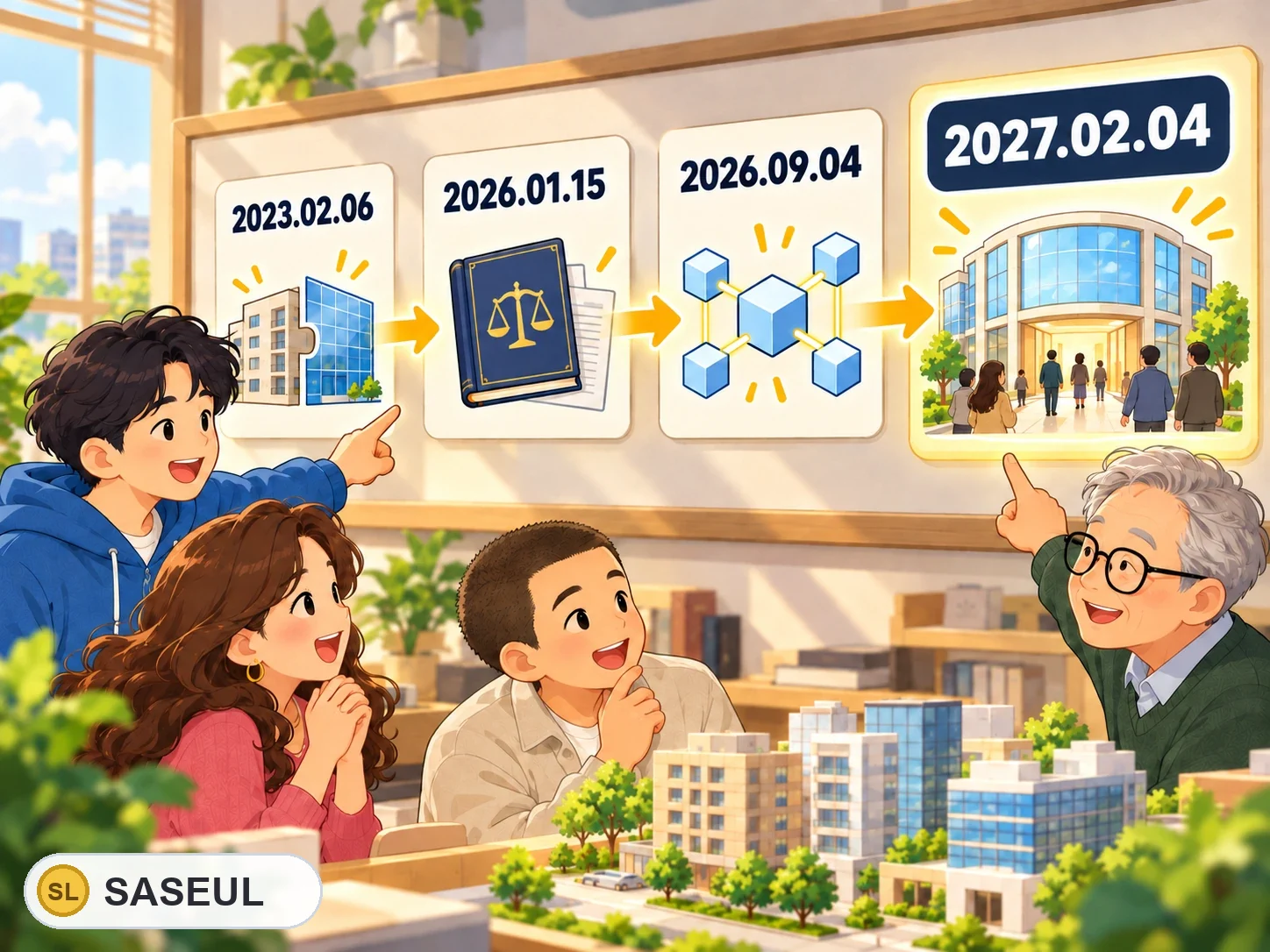
| Date | What happened (Financial Services Commission documents) |
|---|---|
| February 6, 2023 | Plan for issuing and trading security tokens announced |
| January 15, 2026 | Revisions to the Electronic Securities Act and the Capital Markets Act pass a plenary vote in the National Assembly |
| February 2026 | Revised Electronic Securities Act promulgated |
| February 13, 2026 | Preliminary approval for 2 OTC exchanges for fractional investment (places that trade fractional investment securities, like pieces of buildings; not related to SASEUL) |
| September 4, 2026 | Security token policy direction announced |
| February 4, 2027 | Law set to take effect |
I couldn't find the revised enforcement decree with the detailed rules in the FSC's press release list on September 29, 2026. According to news reports, the 2 OTC exchanges applied to the FSC and the Financial Supervisory Service for final approval on August 10, 2026. As of September 30, 2026, there was no announcement of final approval in the press releases of the FSC or the Financial Supervisory Service.
What should you watch out for?
Security tokens are still an investment. If the building loses value or the business doesn't go well, you can lose money. The blockchain ledger only protects the record of who owns how many pieces. It doesn't protect the building's price.
You might not be able to sell right away when you want to. According to the FSC's February 2026 document, the resale channels of the 4 exempted companies that had launched services traded about 14.5 billion KRW in total over all of 2024, counted on the buying side. The FSC called it a small market.
The 6 companies mentioned earlier are all the ones that got the exemption. The 4 are the ones the same document says actually launched services.
From now on, pieces will trade on OTC exchanges (places outside the stock exchange where pieces are bought and sold; not related to SASEUL). The FSC said that for regular investors, the amount bought in a year minus the amount sold will be capped at 100 million KRW per exchange.
If what's first written down is wrong, the ledger stays wrong too. Whether the building really exists and whether the contract is right has to be checked outside the ledger, by people and institutions.
Putting something on just any blockchain doesn't make it a security token either. The Korea Securities Depository's ledger standards guide (September 2026) bans creating or passing around coins used for fees while processing securities records. The FSC said brokering security tokens without a license breaks the law.
What kind of blockchain SASEUL is, see SASEUL basic facts. What SASEUL coin is used for right now is in What Is SASEUL Coin (SL) Used For?. The 6-of-9 signatures are explained in SASEUL's two-ledger structure.
Sources
- Financial Services Commission (Korea) press release · Plan to set up rules for issuing and trading security tokens (in Korean) · 2023-02-06, checked 2026-09-29 (the security and bowl comparison, how to decide what's a security)
- Financial Services Commission (Korea) press release · Revisions to the Electronic Securities Act and Capital Markets Act for security tokens and trading investment contract securities pass the National Assembly (in Korean) · 2026-01-15, checked 2026-09-29 (definition of the distributed ledger, takes effect 1 year after promulgation, brokering without a license breaks the law, art and hanwoo securities being issued)
- Financial Services Commission (Korea) press release · Security token policy direction announced (3rd meeting of the public-private security token council) (in Korean) · 2026-09-04, checked 2026-09-29 (revised in February, set to take effect 2027-02-04, yearly net buying cap of 100 million KRW per OTC exchange, Korea Exchange can open a market)
- Korea Securities Depository · Standard requirements guideline for security token distributed ledgers (Attachment 3 to the FSC's September 4 press release, PDF) (in Korean) · checked 2026-09-29 (page 14 limits on participants, page 31 ban on crypto used for fees)
- Financial Services Commission (Korea) press release · Preliminary approval for beneficiary certificate OTC brokerage (fractional investment OTC exchanges) (in Korean) · 2026-02-13, checked 2026-09-29 (table of the 6 exempted companies, about 14.5 billion KRW traded in 2024, buying side)
- Financial Services Commission (Korea) press release · On December 18, the FSC designates 9 innovative financial services (in Korean) · posted 2019-12-19, checked 2026-09-29 (Kasa Korea's distributed-ledger-based real estate trading platform)
- Financial Services Commission (Korea) press release · New innovative financial service designation for opening an exchange market for new fractional investment securities (in Korean) · 2023-12-13, checked 2026-09-29
- Financial Services Commission (Korea) · KRX gold spot market opens and trading begins (in Korean) · 2014-03-24, checked 2026-09-29 (trading in 1g units)
- The Korea Financial Times · KDX and NXT consortium apply for final approval as fractional investment OTC exchanges (in Korean) · 2026-08-11, checked 2026-09-30 (applications filed on August 10)
- The Korea Financial Times · Nexchange, the company preparing a fractional investment OTC exchange, launches with Jeong Yu-shin as first CEO (in Korean) · 2026-09-29, checked 2026-09-30 (under final-approval review together with KDX)
- SASEUL Docs · SL · version of 2025-04-09, checked 2026-09-29 (fees are paid in SL)
- SASEUL Docs · Node Overview · updated 2026-03-09, checked 2026-09-30 (SL comes only from mining)
- CoinMarketCap · About SASEUL · the project's own description, checked 2026-09-29 and 2026-09-30 (6-of-9 signatures, never sold, no share for the team)
- SASEUL GitHub · sample-contracts · checked 2026-09-30 (token example contracts in example/token, token issuing tool tools/token-mint)
- Official SASEUL Telegram notice #13 · version 2.1.2, plan for the token issuance cost · 2022-09-09, checked 2026-09-30
7 Financial Services Commission documents and the attached guide, SASEUL's official docs and the CoinMarketCap description were all opened and checked directly on September 29, 2026. On September 30, 2026, I also checked SASEUL's official docs (Node Overview), the official GitHub examples, notice #13, 2 news articles on the OTC exchanges and searches of the FSC's and the Financial Supervisory Service's press releases.