Does SASEUL Have Two Blockchains? Resource Chain vs Main Chain, 9 Validator Seats and Finality Time
Does SASEUL have two record books?
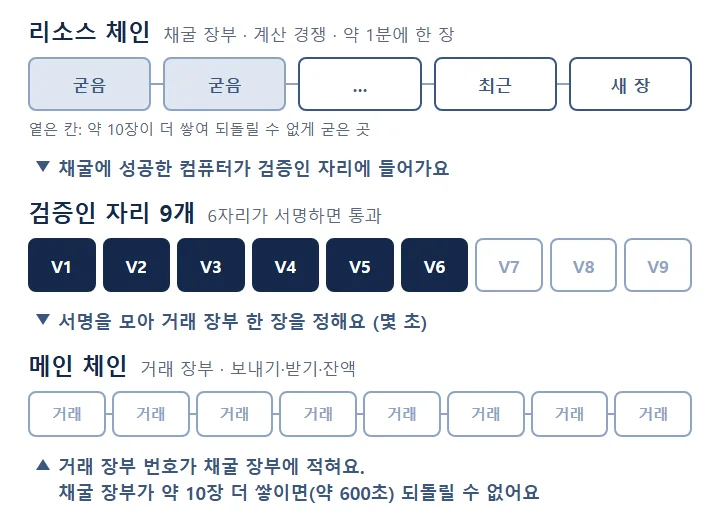
Yes. The mining record book picks validators, and validators write the transaction record book
Resource chain
Mining record book. About one page a minute
9 validator seats
Taken in turns by computers that win at mining
Main chain
Transaction record book. Goes through when 6 seats sign
Locked in
After about 10 more mining pages (per the docs)
Yes, SASEUL has two record books. The one where mining happens is called the resource chain (Resource Chain), and the one that records transactions is called the main chain (Main Chain). The official docs overview (updated March 9, 2026) says the two record books run separately.
The two record books aren't cut off from each other. A computer that wins in the mining record book becomes one of the people who write the transaction record book, that is, a validator (the role that checks and signs transactions). This link is the part of how SASEUL coin works that people most often get confused about.
What does each record book do?
The resource chain runs on proof of work (the side that does lots of calculating and finds the answer first wins). This is where you mine with a graphics card. The official docs say this record book handles mining, picking validators and handing out resource (the mining reward).
The main chain records transactions like sending and receiving, and changes in balances. There's no calculating race here. Validators gather signatures under SASEUL's own rule, called HAP-2, to settle each block (one page of the record book).
| Resource chain (mining record book) | Main chain (transaction record book) | |
|---|---|---|
| What it does | Mining, picking validators, handing out rewards | Records transactions and balance changes |
| How a page is settled | Calculating race (proof of work) | Gathering validator signatures (HAP-2) |
| Target gap | 60 seconds (CoinMarketCap project profile) | Couldn't find it in public sources |
| Pages so far (9:23, September 27) | 2,324,047 | 4,404,682 |
| Average gap since the start (worked out) | About 59 seconds | About 31 seconds |
The average gap is the time from the first block (4:49 a.m., May 17, 2022, Korea time) to 9:23 on September 27, divided by the number of pages. On average, the mining record book has piled up at about one page a minute (the gaps vary a lot).
Why it's split in two is explained in the whitepaper on the official GitHub (written August 2022). It says that with proof of work alone, transactions take a long time to lock in, and if you just trust validators, there's a risk they could rewrite the whole record book. So the calculating race picks the validators, and the chosen validators write transactions quickly.
Who gets to be a validator?
A node (a computer holding a copy of the record book) that wins at mining. The official docs say a node that wins at mining keeps being a validator for a set period, and several validators take part in making blocks at the same time. The whitepaper also says that even when the next miner comes along, a validator doesn't drop out right away but holds its seat for a while.
There are 9 seats. The Validators box on the official explorer's statistics screen has 9 rows, V1 to V9. The CoinMarketCap project profile says a block is valid when 6 of the 9 seats sign.
The whitepaper explains that a block is settled when more than 66% of validators back the same proposal. 6 of 9 seats is 66.7%, so the two explanations agree.
What validators get as a reward is covered in the mining rewards post.
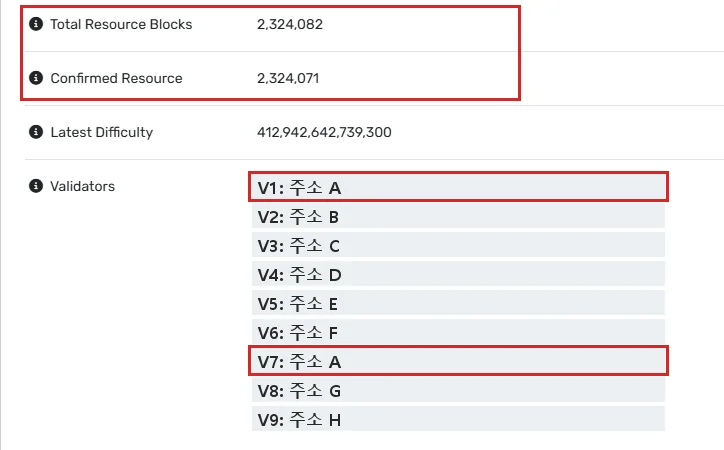
What does it mean when one address takes two seats?
It looks like one computer mined several recent blocks. The 9 seats the explorer showed at 9:55 on September 27 were matched against the mining record book. The 9 seats were the same as the "Next Validator" addresses of the 9 latest confirmed mining pages, right down to the order.
| Time checked (September 27) | Seats held by the same address | Different addresses |
|---|---|---|
| 9:23 | Some addresses held two seats each | 7 |
| 9:52 | Two addresses with two seats each (V1=V8, V2=V5) | 7 |
| 9:55 | One address in three seats | 7 |
| 10:00 | One address in two seats (V1=V7) | 8 |
It keeps changing even within 30 minutes, because the validator seats rotate with the mining results.
From here on it's a guess. In the 9:55 record, each block from the validator address holding three seats paid its reward to a different miner address. This may be one node gathering and processing mining for several people (or several receiving addresses). A mining pool (a group that mines together and splits the coins) could work this way. Who runs that node is unknown.
Going by the numbers alone, if one address takes four or more seats, the rest have five or fewer, so it's hard to get the 6 signatures. But whether two seats held by one address actually count as two signatures couldn't be found in public sources.
When the validator role wobbles, the transaction record book really does slow down. The official Telegram notice reported that from 7:32 p.m. on June 14, 2026 (Korea time), some nodes that won at mining couldn't make main blocks. The team started more mining nodes, and early the next morning put out version 2.2.0.4 and asked people to update their mining nodes.
How long until a transaction is final?
It varies by source. Final means the record is locked in and nobody can reverse it. Even official sources give different numbers.
| Source (checked September 27, 2026) | Time given | What it's about |
|---|---|---|
| Official docs overview (updated March 9, 2026) | 6 to 8 seconds | Finality time on the current network |
| Official website FAQ | About 4 seconds | Transaction finality worldwide |
| Official website terminology | About 4 seconds | Main chain transaction confirmation. The resource chain works in a way similar to Bitcoin |
| Official website How it Works | 2 to 6 seconds on average | Finality time |
| CoinMarketCap project profile | About 4 seconds to process, locked in after about 600 seconds | Locked in for good once 10 more resource blocks are added |
A clue to the different numbers is in the command guide in the official docs. The node status screen shows two separate lines, "Committed" and "Fixed checkpoint".
- Committed: the latest height the validators have checked. It says this can still be reversed at shallow depth
- Fixed checkpoint: the point behind which nothing can be reversed. It says this is about 10 blocks behind Committed
The official explorer has two similar numbers. At 9:52 on September 27, the total mining pages (Total Resource Blocks) were 2,324,072 and the confirmed mining pages (Confirmed Resource) were 2,324,062, exactly 10 apart. At 10:00 they were 11 apart.
So the guess is this. The few seconds is how long it takes the validators to accept a page of the transaction record book. The roughly 600 seconds (10 minutes) is how long it takes for about 10 more mining pages to pile up so that record can't be reversed. The whitepaper also says transaction pages not yet written into the mining record book are treated as "provisional".
Why it's 4 seconds in one place and 6 to 8 in another is unknown. The official website's How it Works page says it's 3 seconds within Asia-Pacific alone, and about 1 second within a single country. It seems to depend on the range the number was measured over.
When sending or receiving a large amount, first check which meaning "final" has. Even if it shows up on the explorer in a few seconds, it's safer to assume it isn't locked in for good until about 10 minutes have passed.
Where can I check this myself?
In the Overview near the bottom of the official explorer's statistics screen, you can see total mining pages, confirmed mining pages and the 9 validator seats. Click a page in the mining record book list and the Miner and Next Validator boxes appear separately. The transaction page number that mining page points to (main_height) is listed too.
Basic SASEUL numbers are in SASEUL basic facts, and what a pool is, is in what is a mining pool.
For node runners: seeing both heights with a command
This command is from the command guide in the official docs (updated March 9, 2026).
sudo docker exec -it saseul-node saseul-script info
In the [Chain Status] part of the output, Committed and Fixed checkpoint are shown separately for the resource and main record books. The docs' sample output is resource=2036197, main=3410001 (Committed) and resource=2036183, main=3409963 (Fixed checkpoint). The [Validators] part shows the validators that took part in recent agreement.
Sources
- Official SASEUL docs · Node Overview (two record books, HAP-2, validators, 6 to 8 second finality) · version updated 2026-03-09, checked 2026-09-27
- Official SASEUL docs · Command Line Interface (Committed, Fixed checkpoint about 10 blocks) · version updated 2026-03-09, checked 2026-09-27
- Official SASEUL GitHub · whitepaper "SASEUL: Universal Computer" (Dual Chain, backing from more than 66% of validators, provisional records) · PDF written 2022-08-09, checked 2026-09-27
- CoinMarketCap · About SASEUL (6 of 9 seats sign, about 4 seconds, 10 resource blocks about 600 seconds, 60 second target gap) · the project's own description, checked 2026-09-27
- Official SASEUL website · FAQ (about 4 seconds) · checked 2026-09-27
- Official SASEUL website · Terminology (main chain about 4 seconds, resource chain confirmation similar to Bitcoin) · checked 2026-09-27
- Official SASEUL website · How it Works (2 to 6 seconds on average, 3 seconds in Asia-Pacific) · checked 2026-09-27
- Official SASEUL explorer · Statistics (page counts, confirmed mining pages, 9 validator seats) · checked 2026-09-27 09:23, 09:52, 10:00
- Official SASEUL explorer · Resource Blocks (Miner, Next Validator boxes) · checked 2026-09-27 09:55
- Official SASEUL Telegram notice #78 (main block creation delay) · 2026-06-15 00:50 (Korea time)
- Official SASEUL Telegram notice #79 (2.2.0.4 released) · 2026-06-15 06:52 (Korea time)
Other checked records are in the archive (a collection of past records).