What Is a Mining Pool? SASEUL Solo vs Pool Mining on One GPU
What is a mining pool?
Alone, a whole block about once every 6 days. In a pool, a little, far more often than alone
Mining alone
You get coins only on days you find the answer
Mining in a pool
The group splits its coins by how much each added
A mining pool (a group that mines together and splits the coins) is where people put their calculating power together and mine as a team. When coins come in, they're split by how much work each person did.
Mining is like a lottery. Find the answer that lets you attach a new block (one page of the record book) and you get coins, but who finds it is luck. Scratch cards alone and you may wait a long time for a win.
Scratch together and split the winnings, and you get a little, but often. That "place where people scratch together" is a pool.
How long does it take to mine alone on one card?
You work it out by comparing the card's hashrate (calculating speed) with the total for everyone mining SASEUL. Here it is with the numbers from September 27, 2026.
| What | Number | Where from |
|---|---|---|
| Calculating speed of the one graphics card in the record | About 860 MH/s (more than 800 million a second) | Mining program screen (September 15) |
| Everyone mining SASEUL, added up | About 6.88 TH/s | Pool site front page. Working it out from the difficulty on the official block explorer's statistics screen gives the same value (September 27) |
| New blocks added by mining | About one a minute, about 1,440 a day | Worked out from two readings of the block number (September 23 → September 27, see Sources below) |
The explorer screen shows it as 6.26 TH/s. That's the same value, just written in units of 1,024 multiplied four times (about 1.1 trillion) instead of 1 trillion.
This one card is about 0.012% of all of SASEUL (0.86 ÷ 6,880). Cut all of SASEUL into 10,000 slices and it's a little more than one slice.
Multiply 1,440 a day by 0.012% and you get about 0.18 blocks a day, or one block every 5.6 days on average.
So the average is about 6 days. It doesn't come like clockwork every 6 days. With good luck you find one in two days.
With bad luck you could find nothing for weeks. And the electricity bill keeps running the whole time. Whether the mining program can mine alone without a pool couldn't be confirmed.
How do you get paid in a pool?
A pool gathers its members' calculating speed to find blocks. When it finds one, it hands out coins by how much calculating each member added.
According to saseulmine.com's guide, coins are handed out once a day. A share smaller than the set minimum carries over to the next time.
How a pool splits coins, going by saseulmine.com's guide
Everyone adds calculating
The pool keeps count of who calculated how much
The pool finds a block
Whoever found it, the coins belong to the group
The fee comes off
Out of 100, 80 go to the people mining
Split by calculating added
Once a day. Below the minimum, it waits for next time
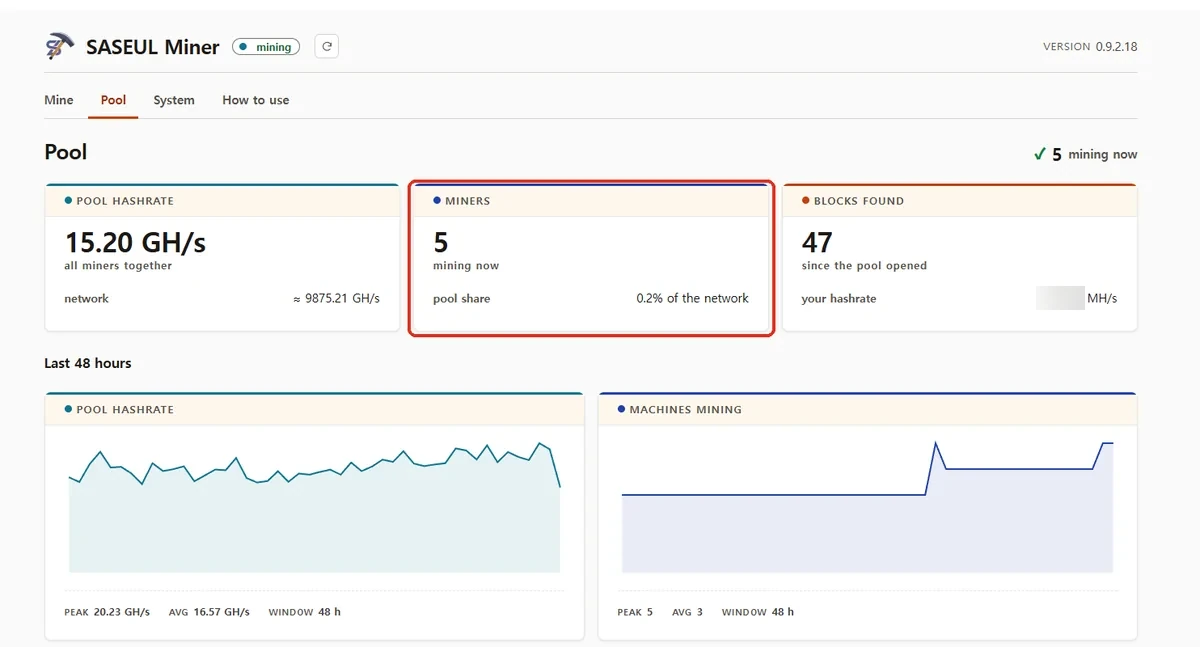
But the size of the pool matters too. The numbers on the same pool site's front page changed this much from day to day, and even from hour to hour on the same day.
| When | Calculating speed gathered in the pool | Share of all of SASEUL (shown on the pool site) | Average time to find one block |
|---|---|---|---|
| September 23, 12:33 | 52.08 GH/s | 0.8% (8 out of 1,000) | About 2 hours |
| September 23, 18:33 | 12.80 GH/s | 0.2% (2 out of 1,000) | About 9 hours |
| September 27, 9:45 | 41.54 GH/s | 0.6% (6 out of 1,000) | About 3 hours |
The front page number is a moment-by-moment value, so it jumps around a lot. The 48-hour graph on the same front page puts the pool's average at about 20 GH/s from 1 p.m. on September 25 to noon on September 27.
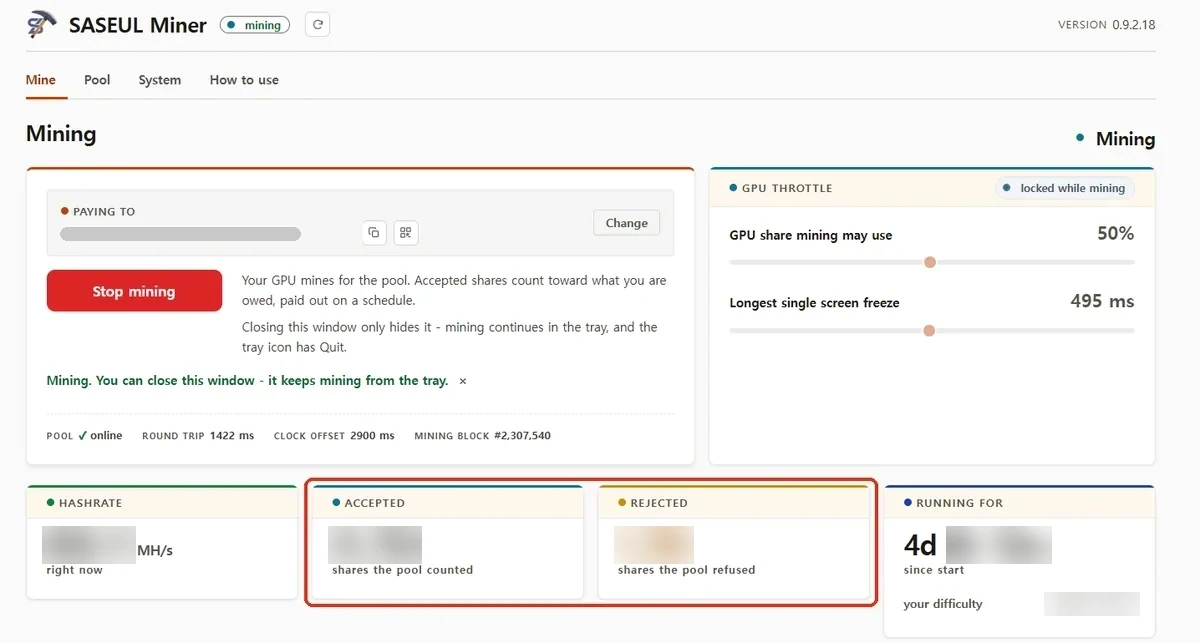
At 9:45 on September 27, 6 machines were running in this pool. On the September 15 mining program screen, it was 5 people.
When a pool is small, the gap between blocks gets longer. Then the days coins are handed out get uneven too. A 28-day record on one graphics card had three days with nothing, even among the 13 days with the card fixed at 50% (one-month record).
How many coins one block pays and how that shrinks over time is in SASEUL mining rewards.
What should you look at when choosing a pool?
- Whether a record is left in the public record book when it pays out. You check this on the block explorer (explorer.saseul.com, the site that shows SASEUL's record book to anyone). If you can see coins coming in to your wallet address (like an account number for receiving coins), you can weed out pools that vanish without paying
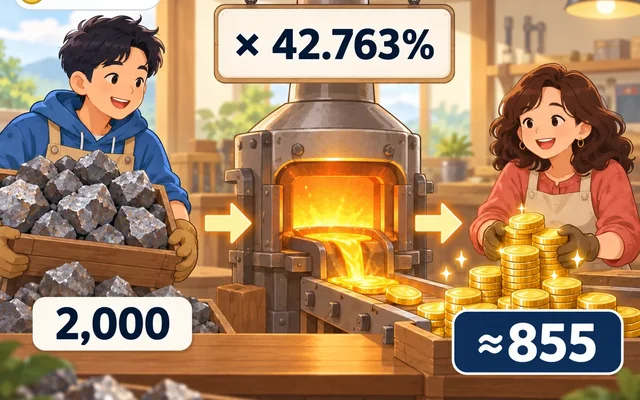
- How big a cut it takes (the fee). saseulmine.com says 80% to miners, 10% to the person who referred them, and 10% to the pool. Mine 100 coins and 80 go to the people mining
- Whether it publishes a value to check that the file you download is the real one
- How far away the pool's computer is. If it's far, calculating results arrive late and more get rejected. On the record from this one card, about 5% were rejected, or about 5 out of 100
- Size. If it's too small, the gap between payouts gets long
In a notice on September 15, 2026, the SASEUL team named three pools: saseulpool.com, saseulmine.com and rabbitminer.cc.
None of the three has a formal tie with the SASEUL team. The notice also says it doesn't vouch for how reliable they are (notice).
What each of the three pools' guides says is in the mining guide. The same notice also mentions another way to take part instead of a pool: running your own computer that holds a copy of SASEUL's record book.
What if I have several computers?
According to the pool's guide, you enter the same wallet address on every computer. The calculating from all of them adds up in one address, and you're paid on that.
For setup, see how to set it up. What kind of coin SASEUL is, is covered in SASEUL basic facts.
Sources
- SASEUL notice channel, notice introducing the pools · 2026-09-15
- Official SASEUL explorer Statistics (shown as about 6.26 TH/s = about 6.88 TH/s in standard units, resource block 2,324,047) · checked 2026-09-27 09:23
- saseulmine.com front page (resource block number 2,318,825, pool numbers) · checked 2026-09-23 18:33
- saseulmine.com front page (pool 41.54 GH/s, network about 6.88 TH/s, 6 machines, 0.6%, how coins are handed out and the fee) · checked 2026-09-27 09:45
- saseulmine.com front page, 48-hour pool speed graph (September 25 13:00 to September 27 12:00, average 20.12 GH/s, peak 23.62 GH/s) · checked 2026-09-27 12:46
- Block interval: 2,324,047 − 2,318,825 = 5,222 blocks divided by 86 hours 50 minutes (September 23 18:33 → September 27 09:23) → about 60 an hour, about 1,440 a day
- SASEUL Miner Pool tab screen · 2026-09-15
The time it takes when mining alone is worked out from these numbers.