What Does the T in SASEUL Difficulty Mean? Difficulty, Network Hashrate and Block Time
What does the T in SASEUL difficulty mean?
It's the average number of calculations per block. Divide by 60 seconds and you get the total calculating speed
About 413trillion
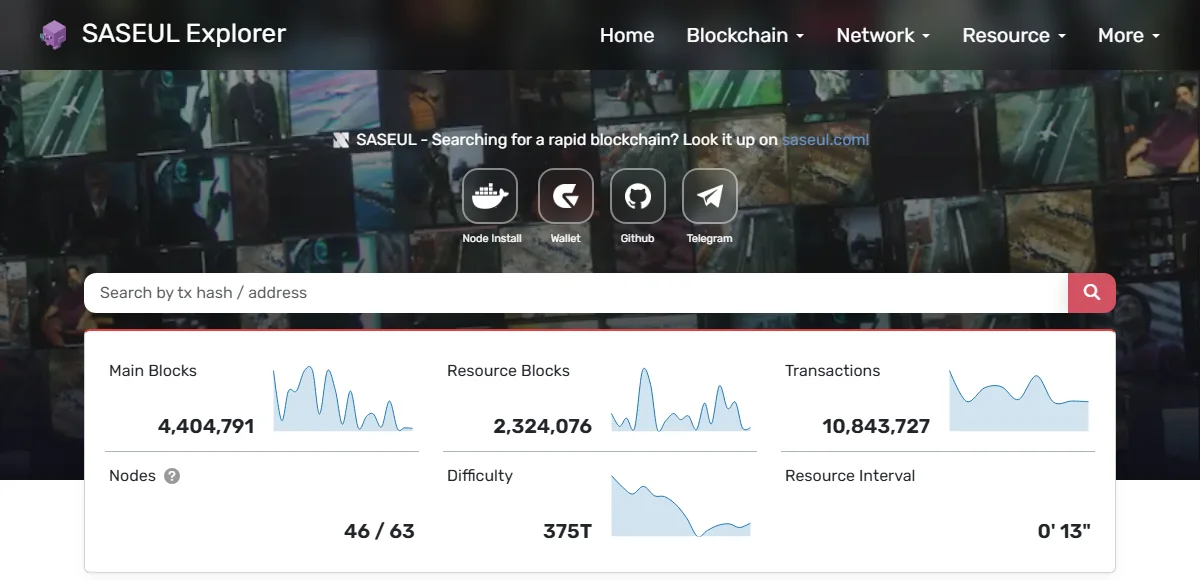
Difficulty 375.57T (explorer, September 27)
60sec
Target gap for one mining record page
6.88trillion/sec
Calculating speed of all of SASEUL (shown as 6.26 on the explorer)
Difficulty can be read as the average number of calculations it takes to find one block (one page of the record book). The official explorer's difficulty of 375.57T on September 27, 2026 is about 413 trillion calculations. Divide this number by 60 seconds and you get the calculating speed of everyone mining SASEUL.
Don't read the "T" in the explorer's difficulty as "trillion". The explorer's T is a unit of 1,024 multiplied four times (about 1.1 trillion). That's why the explorer (6.26 TH/s) and the pool site (6.88 TH/s) seem to show different numbers. This is an easy place to get confused in SASEUL coin mining numbers.
What does difficulty count?
In proof of work (the side that does lots of calculating and finds the answer first wins), you keep plugging in different numbers and guessing until you find an answer that fits the condition. Difficulty shows how rare that answer is, that is, how many guesses it takes on average. In lottery terms, it's "how many scratch cards you have to scratch on average to get one win".
So far this is proof of work in general. No official explanation of exactly how SASEUL sets its difficulty could be found.
But the official explorer uses it in this sense. The public script that builds the explorer screen works out calculating speed as "difficulty ÷ 60". That treats difficulty as the average number of calculations per block, and one block as 60 seconds.
Do 375.57T and 6.26 TH/s match up?
Yes. Lower on the same screen, the latest difficulty (Latest Difficulty) is shown without a unit. On September 27 it was 412,942,642,739,300.

Divide this number by the explorer's T (1,024 multiplied four times, 1,099,511,627,776) and you get 375.57. The 375.57T on the card at the top is exactly this value.
| Calculation (inference and cross-check) | Result |
|---|---|
| 412,942,642,739,300 ÷ 1,099,511,627,776 | 375.57 (difficulty on the explorer card) |
| 412,942,642,739,300 ÷ 60 | 6,882,377,378,988 (about 6.88 trillion a second) |
| 6,882,377,378,988 ÷ 1,099,511,627,776 | 6.26 (calculating speed on the explorer card) |
| 6,882,377,378,988 ÷ 1,000,000,000,000 | 6.88 (calculating speed on the pool site) |
So the two numbers look like the same difficulty written in different units. The explorer uses units of 1,024, and the pool site uses units of 1,000. Whether the pool site actually calculates it this way is unknown. The numbers match to the third digit, which is why this is the guess.
The September 23 record matches the same way. That day, the difficulty on the explorer's front page was 363T, and the network hashrate (the calculating speed of everyone mining) on the pool site was 6.67 TH/s. 363 times 1.0995, divided by 60, is 6.65. The explorer's front page drops the decimals. The real difficulty was about 363.85T, so it's slightly off.
How big is that calculating speed?
About 6.88 trillion calculations a second. In terms of a card with a hashrate (guesses per second) of about 860 MH/s, that's the power of about 8,000 cards put together.
That same one card mining alone would take about 5.6 days on average to find a block (413 trillion ÷ 860 million ≈ 480,000 seconds). It's an average, so it might find one in a day or it might take two weeks. That's why people use a pool, a group that mines together and splits the coins.
On days when difficulty was higher, the same card takes longer. The mining page at 12:06 pm on September 15 had a difficulty of about 539T (about 593 trillion).
Average days for one card at about 860 MH/s to find a block alone
If difficulty is about 1.4 times higher, the wait is about 1.4 times longer too. Over the same stretch of time, you find blocks that much less often.
Does a block really come out every minute?
On average, almost. This was worked out from the number of mining record pages (resource blocks) on the official explorer.
| Time checked | Mining record page number |
|---|---|
| 18:33, September 23, 2026 | 2,318,825 |
| 9:23, September 27, 2026 | 2,324,047 |
| Difference | 5,222 pages, about 5,210 minutes |
5,222 pages piled up over about 5,210 minutes. That's about 59.9 seconds per page, or about 1,440 pages a day (over the last four days). A day has 1,440 minutes, so that's about one page a minute. The CoinMarketCap project profile also says the target gap is 60 seconds.
The gap between each page jumps around. Looking at the gaps between the 20 pages added from 9:36 to 9:54 on September 27, the shortest was 5 seconds and the longest was 194 seconds. The average was 58.5 seconds. Finding the answer is a lottery, so the gaps aren't even.
How has difficulty moved?
Over two weeks it went down a lot, then came back up a little. This is the difficulty chart (Difficulty History) on the official explorer's statistics screen.
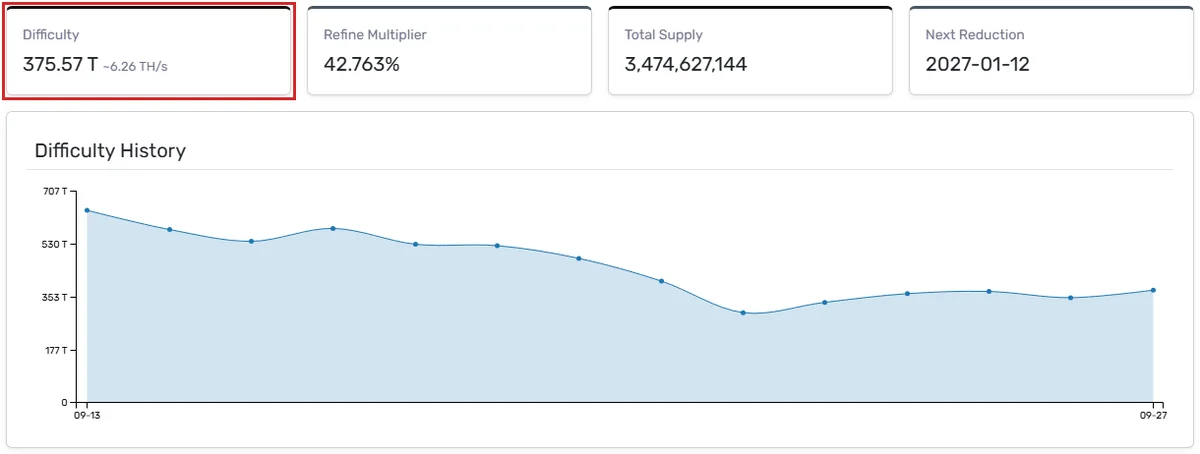
The left end of the chart (around September 13) is in the 600T range, the lowest point is near 300T, and the right end is the current 375.57T. There are 14 dots. Whether each dot is one day is unknown.
In proof of work generally, when there's less mining calculation, blocks come slower, so difficulty is lowered to keep the gap steady. When and by what rule SASEUL changes its difficulty couldn't be found in public documents. Around 9:55 on September 27, the latest 20 pages all had the same difficulty. It most likely changes once every few pages rather than every block.
Over a longer stretch, difficulty jumped to about 11 times within about a month after the official GPU miner came out on February 13, 2026, then came back down. Before that, between August 2024 and January 2025, it also jumped about 230 times. The numbers by date are in the 20,000 nodes post.
Which hash algorithm does SASEUL mining use? (No name found in official sources)
Its name couldn't be found in public documents (as of September 27, 2026). The official docs, official website and the whitepaper on the official GitHub were searched.
The name SHA-256 does come up. But the Specification page in the official docs describes it as used for making addresses, and the How it Works page on the official website describes it as used for checking stored data. Neither says it's used for mining calculations. The whitepaper also only describes proof of work in general terms.
If you see a claim like "SASEUL uses the ○○ algorithm", check the source first. The first question is whether that name appears in official sources.
Difficulty in the official docs' sample output
In the node status sample output in the official docs' command guide (updated March 9, 2026), the difficulty of mining page 2,036,197 is shown as difficulty: 720140924964913. Worked out the same way, that's about 655T in units of 1,024, or about 12 trillion calculations a second.
It's a sample screen, so it can't be taken for certain as the whole network's value that day. Use it only as a reference to compare with the morning of September 27 (about 413 trillion).
Where can I check this myself?
Look at the difficulty card and the Latest Difficulty lower down on the official explorer's statistics screen together. Click a page in the mining record list (Resource Blocks) and it shows that page's difficulty (Difficulty) and time.
Calculating speed units are in the glossary, and how to work out one card's share is in what is hashrate. For basic numbers, see SASEUL basic facts.
Sources
- Official SASEUL explorer · Statistics (Difficulty 375.57 T ~6.26 TH/s, Latest Difficulty 412,942,642,739,300, Difficulty History) · checked 2026-09-27 09:23, 09:52, 10:00
- Official SASEUL explorer screen script app.min.js (v1.6.3) (difficulty ÷ 60, shown in units of 1,024) · checked 2026-09-27
- Official SASEUL explorer · Resource Blocks (mining page times and difficulty) · checked 2026-09-27 09:55
- Official SASEUL explorer · mining page 2,307,600 (2026-09-15 12:06, difficulty 592,512,823,647,550) · checked 2026-09-28
- saseulmine.com front page (network about 6.88 TH/s) · checked 2026-09-27 09:45, 09:58
- CoinMarketCap · About SASEUL (resource chain target gap 60 seconds) · the project's own description, checked 2026-09-27
- Official SASEUL docs · Command Line Interface (difficulty in the sample output) · version updated 2026-03-09, checked 2026-09-27
- Official SASEUL docs · Specification (SHA-256 and RIPEMD-160 for making addresses) · version updated 2024-04-20, checked 2026-09-27
- Official SASEUL website · How it Works (SHA-256 for checking stored data) · checked 2026-09-27
- Official SASEUL GitHub · whitepaper "SASEUL: Universal Computer" (general description of proof of work) · PDF written 2022-08-09, checked 2026-09-27
- The September 23 numbers are from this blog's network record (2026-09-23 18:33, saseulmine.com and explorer.saseul.com front pages)
Other checked records are in the archive (a collection of past records).