If More People Mine SASEUL at Home, What Changes and for Whom? Mining Farms, Pool Miners and Coin Holders

If more individuals mine, what changes and for whom?
The amount stays the same. Each share gets smaller, and power spreads out
More people mine through pools
SASEUL's total calculating power grows
Difficulty goes up
Still about one page a minute
Same amount of new coins
More people split the same amount
Even if more individuals mine SASEUL through a mining pool (a group that mines together and splits the coins), the amount of new SASEUL coin (SL) doesn't go up. The same amount just gets split among more people.
So anyone already mining, whether a big farm or one person, sees their share shrink a little. For people who only hold the coin, two things change: no extra coins get released, and it gets harder for any one party to control the record book.
The three groups want different things: a bigger share, a steady share, a record book they can trust
The table below is my own way of splitting it up. A mining farm is a place that gathers lots of machines and mines at scale. A holder is someone who doesn't mine and just holds the coin.
| Who | What they want (my view) | If more individuals mine through pools |
|---|---|---|
| Mining farm | A bigger share from the same machines | Share goes down |
| Individual in a pool | Small but steady payouts | Share goes down, but payout days get more even |
| Holder | No careless coin inflation, a safe record book | No extra coins, and spread-out power is safer |
I couldn't confirm from public data whether SASEUL has any big mining farms, or how many.
New coins are set by rules, so more miners don't mean more coins
Each block (one page of the record book) comes with a fixed reward, and a block gets added about once a minute. More people doesn't make pages get added faster.
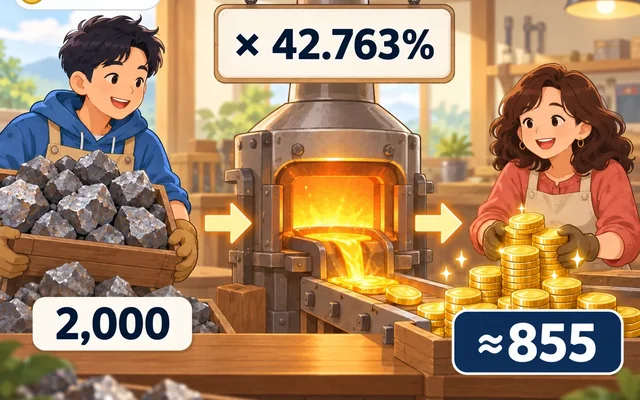
The official docs say that each time a node takes a turn as a validator (the role that checks and signs transactions), it earns contribution points, and that there is a rate for turning those points into SL. When that rate goes down is set by how much has been issued, not by a date (the rewards post).
CoinMarketCap's project description says the mining record book aims for a 60-second gap. From the first mining on May 17, 2022 to October 4, 2,334,418 pages piled up. That's about 59 seconds a page on average.
Over that time, total calculating speed rose and fell a lot. On September 15, 2026 it was about 9.88 TH/s (TH/s means trillions of guesses per second), and on the evening of October 4 it was about 5.82 TH/s. Pages still got added at roughly one a minute.
My read is that this happens because difficulty (how many guesses it takes to find one page) goes up when calculating power grows. The Bitcoin white paper also explains that difficulty rises if blocks come too fast.
When more individuals mine, everyone already mining gets a smaller share
Your share is your calculating speed divided by the total calculating speed. When the total grows, the same machine earns a smaller share.
One graphics card doing about 860 MH/s (MH/s means millions of guesses per second, so about 860 million per second) was 0.0148% of the October 4 total of about 5.82 TH/s. If the total grew by 1 TH/s, that would drop to 0.0126%. Think of it as 1.5 slices out of 10,000 becoming 1.3 slices.
That's the same for farms and for individuals in pools. If you don't add machines, you get less.
There's an upside for individuals in pools, though. A bigger pool finds blocks more often, so payout days get more even. With a small pool, some days you get nothing at all (what a mining pool is).
On October 4, all three public pools combined were under 2% of the total
In notice #84 of September 15, 2026, the SASEUL team introduced three pools. The notice says none of them is tied to the official team. I opened the front page of each one myself between 7:23 and 7:26 pm on October 4 (Korea time, KST).
| Pool | Calculating speed in the pool (GH/s is billions of guesses per second) | Share shown on the site | Machines mining |
|---|---|---|---|
| saseulpool.com | 85.53 GH/s | 1.4% | 17 |
| saseulmine.com | 20.69 GH/s | 0.4% | 10 |
| rabbitminer.cc (a pool site with a SASEUL section) | 0 H/s | not shown | 0 |
Add the three and you get about 106 GH/s. That's about 1.8% of the total of about 5.82 TH/s on the official explorer at the same time.
These numbers change a lot in a short time. On the evening of October 4, saseulmine.com showed 20.69 GH/s at 7:23 pm and 51.40 GH/s eight minutes later. A screenshot taken the day before, in the install post, showed 47.38 GH/s, or 0.8% of the total.

I don't know who mines the other roughly 98%. The explorer's statistics screen shows Active Miners as 44, but it shouldn't be read as a number of people or machines.
The front page of saseulpool.com says "Min 100 GH/s to join". That reads as needing at least 100 GH/s to join.
The more spread out mining power is, the harder it is for one party to control the record book
This is the general idea behind proof of work (whoever does enough calculating to find the answer first wins). The Bitcoin white paper explains that as long as honest nodes hold most of the calculating power, they outpace an attacker. Flip that around, and one party holding a majority is a risk.
SASEUL works a little differently. A node (a computer holding a copy of the record book) that succeeds at mining takes a validator seat for a while (official docs). There are 9 seats, and a page of the transaction record book goes through once 6 seats sign (CoinMarketCap project description).
At 7:23 pm on October 4, the explorer's 9 validator seats were held by 5 different addresses. Whoever mines a lot can pick up several seats.
How SASEUL's two record books work is in the two-chain structure post.
As pools grow, watch for power gathering in a single pool too
In a pool, individuals do the calculating, but it's the pool that finds and submits the blocks. The saseulmine.com front page says it too: "The pool finds the blocks". If hundreds of individuals join one pool, on the record book they can look like one big miner.
On the evening of October 4, the biggest public pool (saseulpool.com) was 1.4% of the total by its own site, far from a majority.
So what should you do? Pick a pool by its payout record, not just its size, and don't pile into one place
- When choosing a pool, look at its payout record along with its size. Anyone can see what came into their wallet address on the official explorer
- If one pool starts taking a big chunk of the total, it might be worth splitting your mining across another pool
- The more people mine, the less the same card earns. Every so often, rerun your power cost with how to work out mining electricity cost
Basic numbers are in SASEUL basic facts.
Sources
- Official SASEUL explorer · Statistics (Difficulty 317.55 T ~5.29 TH/s, Latest Difficulty 349,148,755,554,625 ÷ 60 = about 5.82 TH/s in standard units, Refine Multiplier 42.763%, Resource Blocks 2,334,418, Genesis Mining 2022-05-17 04:55:12, 5 different addresses across 9 validator seats, Active Miners 44) · checked 2026-10-04 19:23 KST
- Official SASEUL explorer front page (Nodes 44 / 58, latest mining block #2,334,418 2026-10-04 19:22:18) · checked 2026-10-04 19:23 KST
- saseulpool.com front page (POOL HASHRATE 85.53 GH/s, Pool Share 1.4%, Rigs 17, Net Hash 5.98 TH/s, "Min 100 GH/s to join") · checked 2026-10-04 19:23 KST
- saseulmine.com front page (POOL HASHRATE 20.69 GH/s, NETWORK ≈ 5.82 TH/s, MACHINES MINING NOW 10, POOL SHARE 0.4%, "The pool finds the blocks") · checked 2026-10-04 19:23 KST
- rabbitminer.cc SASEUL page (Хеш пула 0 H/s, Майнеры 0) · checked 2026-10-04 19:26 KST
- Official SASEUL Telegram notice no. 84 · pool introduction (three pools, not tied to the official team, not vouched for) · posted 2026-09-15, checked 2026-10-04
- Official SASEUL docs · Node Overview (a node that succeeds at mining serves as a validator for a set period) · checked 2026-10-04
- Official SASEUL docs · SL (at least 2,000 per validator turn) · checked 2026-10-04
- CoinMarketCap · About SASEUL (60-second target for the mining record book, 6 of 9 seats sign) · the project's own description, checked 2026-10-04
- Bitcoin white paper "Bitcoin: A Peer-to-Peer Electronic Cash System" (majority of calculating power, difficulty rises if blocks come too fast) · checked 2026-10-04
- Official SASEUL explorer · mining block 2,307,600 (2026-09-15 12:06, difficulty 592,512,823,647,550 ÷ 60 ≈ 9.88 TH/s) · checked 2026-09-27 (recorded in the hashrate post)
- SASEUL Miner Pool tab screenshot (saseulmine.com 47.38 GH/s, network ≈ 5,735.02 GH/s, 0.8%) · the screen shown in the install post
- Math: average per page = 2022-05-17 04:55:12 to 2026-10-04 19:22:18 ÷ 2,334,418 pages ≈ 59.3 sec. One card's share = 0.86 ÷ 5,819 ≈ 0.0148%, assumed 0.86 ÷ 6,819 ≈ 0.0126%. Pool total = 85.53 + 20.69 + 0 = 106.22 GH/s ÷ 5,819 GH/s ≈ 1.8%
I hold SL. I checked the numbers myself by opening the official explorer and the three pool sites between 7:23 and 7:26 pm on October 4, 2026 (KST).