Which Coins Can You Still Mine With a Home GPU in 2026? A Plain Comparison, and Where SASEUL Fits

Can you still mine with a home GPU in 2026?
Yes, a handful of coins. But GPU rules, ASICs and launch history differ
Sept 2022
Ethereum ends mining
GPU coins
Official pages say GPUs work
ASICs arrive
Some coins leave GPUs behind
SASEUL
NVIDIA only, 3 pools in a notice
Yes, a handful. As of October 9, 2026, the official pages of Ethereum Classic (ETC), Ravencoin (RVN) and Ergo (ERG) still describe GPU mining, and SASEUL (SL) mines on NVIDIA GPUs. Kaspa (KAS) used to be a GPU coin, but its own wiki now says it's mined only with ASICs.
So "GPU-mineable" isn't one thing. Before you pick a coin, check five things: which cards work, whether there's a pool, whether ASICs (machines built for one algorithm) are already there, who got the first coins, and the electricity bill.
What changed in 2022? Ethereum stopped mining on September 15, 2022
ethereum.org says The Merge ran on September 15, 2022 and ended Proof of Work (earning coins by doing lots of calculations) on Ethereum. Since then, nobody mines ETH.
Many GPU miners had been mining Ethereum. In a February 22, 2022 page, Ethereum Classic's site welcomed "recently evicted Ethereum miner" readers and said the same hardware can keep mining. That's how many GPU rigs moved on.
How do the GPU coins compare? Here they are side by side, by structure
This table only repeats what each project or its docs say about itself. It's not a ranking, and the order is just the order they launched in.
What the columns mean. Consensus method is the rule for deciding who writes the next page of the ledger. Proof of Work (PoW) means whoever does lots of calculations and finds the answer first gets the coins. Proof of Stake (PoS) picks who writes the ledger by how many coins they've put up, so there's no mining. Some coins mix the two, and some use a new method of their own. To mine with a graphics card the coin has to be PoW-based (that's why Ethereum's switch to PoS ended its mining).
| Coin | Mine with a GPU? (O/X) | Consensus method | Minimum mining spec | ASICs? | How the first coins went out | Source |
|---|---|---|---|---|---|---|
| Ethereum Classic (ETC) | O | Proof of Work (PoW), algorithm ETCHash. Its mining page states a long-term commitment to PoW | Cards with at least 4 GB of memory (hardware guide, February 2022) | Yes, its hardware guide says ASICs are on the market | Continues the original Ethereum chain from 2015. Before that chain launched, ether was sold for 42 days in 2014 | ETC hardware guide, ethereum.org forks |
| Ravencoin (RVN) | O | Looks like Proof of Work (PoW), algorithm KAWPOW. The official intro only says "mining algorithm"; I didn't find the words "Proof of Work" there | No official guidance. The intro only says most consumer grade GPU hardware can mine it | Designed to discourage them, while saying future ASICs may still come | No premine, no ICO, no developer or founder coins | ravencoin.org/about |
| Ergo (ERG) | O | Proof of Work (PoW), algorithm Autolykos | No official guidance. The mining page only says it's friendly to common GPUs | Designed to resist them. Whether any exist, I couldn't confirm | 4.43% of total emission went to the foundation at genesis, the rest to miners | Ergo mining, Ergo emission docs |
| Kaspa (KAS) | Practically X. Technically possible, but the wiki says you'd pay more for electricity than the coins are worth | Proof of Work (PoW), algorithm kHeavyHash (a blockDAG) | No official guidance. The wiki says it's ASIC-only now | Yes, the wiki says it's ASIC-only now | No premine, insider allocation or pre-sales | Kaspa wiki, kaspa.org/lore |
| SASEUL (SL) | O (NVIDIA cards only) | Its own rule (HAP-2) built on Proof of Work (PoW). The official docs say it's built on PoW and doesn't use PoS. CoinMarketCap's tags list SHA-256, but I couldn't confirm the mining algorithm's name in the official docs | An NVIDIA graphics card, its driver and CUDA. AMD and Intel graphics don't work. Which CUDA version fits which card generation is in this blog's mining guide | Couldn't confirm either way | No ICO, IEO or sale, no team, investor or foundation share. All supply from mining | saseulmine.com download, CoinMarketCap, SASEUL docs · Node Overview, this blog's mining guide |
Mine with a GPU? is O when the project's own pages say a graphics card works and X when they say it doesn't. Kaspa is marked "practically X" because its wiki now says it's ASIC-only. Minimum mining spec repeats only what official docs or official mining guides say, and "no official guidance" means I found none.
Words in the table, briefly. ETCHash, KAWPOW, Autolykos and kHeavyHash are the names of each coin's own mining calculation. A blockDAG is a ledger where blocks link up in several branches instead of one line. HAP-2 is the consensus rule SASEUL uses. A treasury is a stash of coins the project holds.
How should you choose? Check five things before the coin name
- Hardware. Look at your card's maker first. Most of these coins don't name a vendor, but SASEUL needs NVIDIA. Memory size matters too: ETC's hardware guide lists cards with at least 4 GB.
- Pool availability. A mining pool (a group that mines together and splits rewards) makes small rigs see coins more often. Check that a pool exists and that its payouts show up on the coin's block explorer.
- ASIC risk. Once ASICs arrive, they do far more work per watt, so a GPU's share shrinks. ETC says ASICs are out, and Kaspa's wiki says GPUs are done there. Ravencoin has changed its algorithm twice to keep ASICs away.
- Launch fairness. In a fair launch (mined-only, no premine or ICO), the first coins went to whoever mined. Where there was a sale or a foundation share, check that the project published the number. Ergo states its 4.43% openly in its docs.
Electricity is the fifth thing, and it depends on your own rate. The electricity cost post shows how to work it out in kWh.
Where does SASEUL fit? NVIDIA-only, small pools, mined-only distribution
SASEUL is a GPU-mineable Proof of Work coin that runs only on NVIDIA cards. The download page of the pool site saseulmine.com says every build of the miner, for Windows and for Linux, needs "an NVIDIA GPU, its driver, and CUDA." So an AMD card can't run them.
On distribution, I'm going by the project description on CoinMarketCap. It says there was no ICO, IEO, private sale or public sale, and no share for the team, investors, a foundation or a treasury. The whole supply is issued through mining. The page doesn't show who wrote that description, so treat it as the project's own account.
The official SASEUL notice #84 (September 15, 2026) listed three pools: saseulpool.com, saseulmine.com and rabbitminer.cc. The same notice says none of them has any affiliation with the official team and it doesn't vouch for them.

For scale, in a screenshot of one SASEUL pool on September 15, 2026, 5 people were mining, about 0.2% of SASEUL's total calculating power. The details are in the 28-day log on one older GPU.
The mining algorithm's name is covered in the table. I also couldn't confirm whether SASEUL ASICs exist in the public sources I read. The basic facts are collected on SASEUL basic facts, and home GPU post covers solo vs pool odds.
So what should you do? Check your card maker, then try with what you already have
- Check whether your card is NVIDIA or AMD. For SASEUL, it has to be NVIDIA.
- Open the official mining page of any coin you're considering. If it mentions ASICs, expect a smaller GPU share.
- Look up how the first coins went out (sale, premine, foundation share) in the project's own docs.
- Work out your power cost with the electricity cost post.
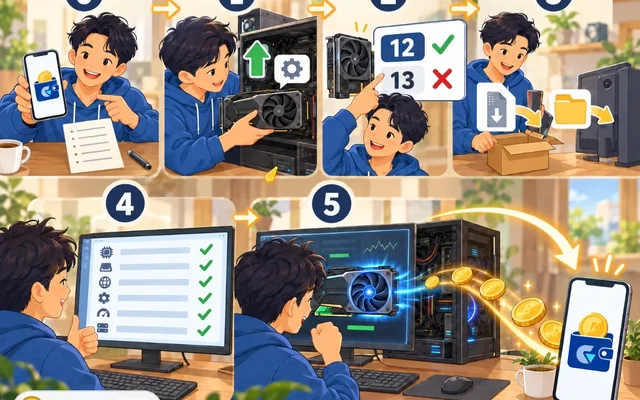
- To try SASEUL, read the mining guide and then follow the setup steps. If CUDA trips you up, see the CUDA errors post.
Rather than buying a new card for this, I'd start with an NVIDIA card you already own and see how it goes.
Sources
- ethereum.org · The Merge (executed September 15, 2022, Proof of Work ended) · page last updated 2026-05-15, checked 2026-10-09
- ethereum.org · Ethereum forks (42-day ether sale from July 22, 2014; miners who refused the July 20, 2016 fork formed Ethereum Classic) · page last updated 2026-06-26, checked 2026-10-09
- Ethereum Classic · Mining Resources (long-term commitment to Proof of Work, inherits miners who previously mined Ethereum) · 2022-02-22, checked 2026-10-09
- Ethereum Classic · Mining Hardware Guide (ETCHash, cards with at least 4 GB, ASICs on the market, "recently evicted Ethereum miner") · 2022-02-22, checked 2026-10-09
- Ethereum Classic · Why Classic? (continuation of the original Ethereum launched in 2015) · 2022-02-22, checked 2026-10-09
- Ravencoin · About the Ravencoin Project (launched January 3, 2018, KAWPOW, two algorithm forks, ASIC-discouraging, no premine, no ICO, no developer or founder coins) · no date on page, checked 2026-10-09
- Ergo Platform · Mining (Proof of Work, Autolykos, ASIC-resistant, friendly to common GPUs) · no date on page, checked 2026-10-09
- ErgoDocs · Emission (mainnet July 2019, foundation 4.43% of total emission, rest to miners) · no date on page, checked 2026-10-09
- Kaspa Wiki · Mining (ASIC-only now, GPU era ended around mid-2023, kheavyhash) · page last edited 2026-07-06, checked 2026-10-09
- Kaspa · Lore (proof-of-work blockDAG, mainnet November 2021, no premine, insider allocation or pre-sales) · no date on page, checked 2026-10-09
- saseulmine.com · Download (needs an NVIDIA GPU, its driver and CUDA; calls itself a "community-run GPU mining pool" and "an unofficial service") · checked 2026-10-09
- Official SASEUL Telegram notice #84 · three mining pools (no affiliation with the official team, no guarantee of trustworthiness) · 2026-09-15, checked 2026-10-09
- CoinMarketCap · About SASEUL (no ICO, IEO or sale, no team, investor, foundation or treasury share, entire supply through mining) · project's own description, checked 2026-10-09
- Ravencoin · Home (KAWPOW as a new mining algorithm) · no date on page, checked 2026-10-22
- SASEUL Docs · Node Overview (HAP-2 is a consensus built on Proof of Work, no Proof of Stake, GPU mining needs an NVIDIA driver) · revised 2026-03-09, checked 2026-10-22
- CUDA version by card generation: the mining guide on this blog
- Record book running since May 2022 without stopping: How to check SASEUL blocks on this blog
- Pool size and days without coins: the 28-day log on one older GPU on this blog (SASEUL Miner pool screen, September 15, 2026)
I hold SL. The official pages of all five coins, the SASEUL notice, the pool site and CoinMarketCap were opened and read in the original on October 9, 2026. No prices or profit figures are given here on purpose. The consensus method and minimum spec cells were checked again on the official pages on October 22, 2026.