Can You Still Mine Crypto on a Home GPU? SASEUL (SL) Can
SASEUL myth check, part 1
SASEUL mines on one home graphics card
What people say
“There are no coins left you can mine on a home computer”
Going by a 28-day record on one graphics card
That's wrong
- Ethereum mining ended in 2022
- Bitcoin is mined with special mining machines
- SASEUL is mined on one graphics card by joining a group that mines together
Yes. SASEUL can be mined with one NVIDIA graphics card in a home computer. The coin you mine on SASEUL is called SL (the short name of the SASEUL coin).
You don't mine alone. You join a mining pool (a group that mines together and splits the coins). There's also a 28-day record from one graphics card a few years old, on home internet.
What is proof of work (PoW)?
Proof of work (PoW) is a system where whoever does lots of calculating and finds the answer first gets the coins. Getting coins this way is called mining. It's like scratch cards: the more you scratch, the better your odds of a win.
Lots of calculating means the computer has to work. That uses electricity.
So "can you mine at home?" really asks whether a home computer can do this calculating. Coins that dropped proof of work can't be mined at all. Coins where special machines compete are hard for a home computer to join.
Why do people say there are no coins left to mine at home?
I'd guess it's mostly because of what happened with two well-known coins.
Ethereum ended proof of work on September 15, 2022, so there's been no mining since. This switch is called "The Merge." It's explained on ethereum.org's page on The Merge.
Bitcoin is mined with machines built only for mining (specialized hardware), says the official Bitcoin site's FAQ (frequently asked questions). In other words, it's not a coin you mine on an ordinary home computer.
These two things seem to be why the saying "there's nothing left to mine at home" spread. But these aren't the only proof-of-work coins. SASEUL is mined with proof of work too.
Did people once say individuals couldn't mine SASEUL either?
Yes. In early 2024, someone on a Korean online forum for miners asked about mining SASEUL.
Another post said it was unclear how to mine, and unclear whether anything was left after paying for the electricity.
Why was it like that back then?
This is my guess. A 2023 article in Jeongbo Tongsin Sinmun (a Korean IT and telecom newspaper) described SASEUL mining as something you took part in by installing a node (a computer holding a copy of the record book). It said you could install a node on a home PC, and setup took about 30 minutes.
A node can use a lot of the internet connection. That may be why the home internet dropped back then. But that method wasn't checked directly, so this isn't certain.
How is it mined now?
It works differently now. You run a mining program on an NVIDIA graphics card and connect it to a pool. The mining program only sends its calculating results to the pool.
Here's the setup behind the 28-day record. There was no separate dedicated line.
| What | Setup behind the record |
|---|---|
| Graphics card | One NVIDIA graphics card a few years old |
| Computer | An ordinary Windows 10 PC |
| Internet | Regular home internet |
| Period | August 18 to September 15, 28 days |
The roughly 860 MH/s in this record (the numbers on the screen below are blurred) is the hashrate (calculating speed). It means more than 800 million guesses a second.
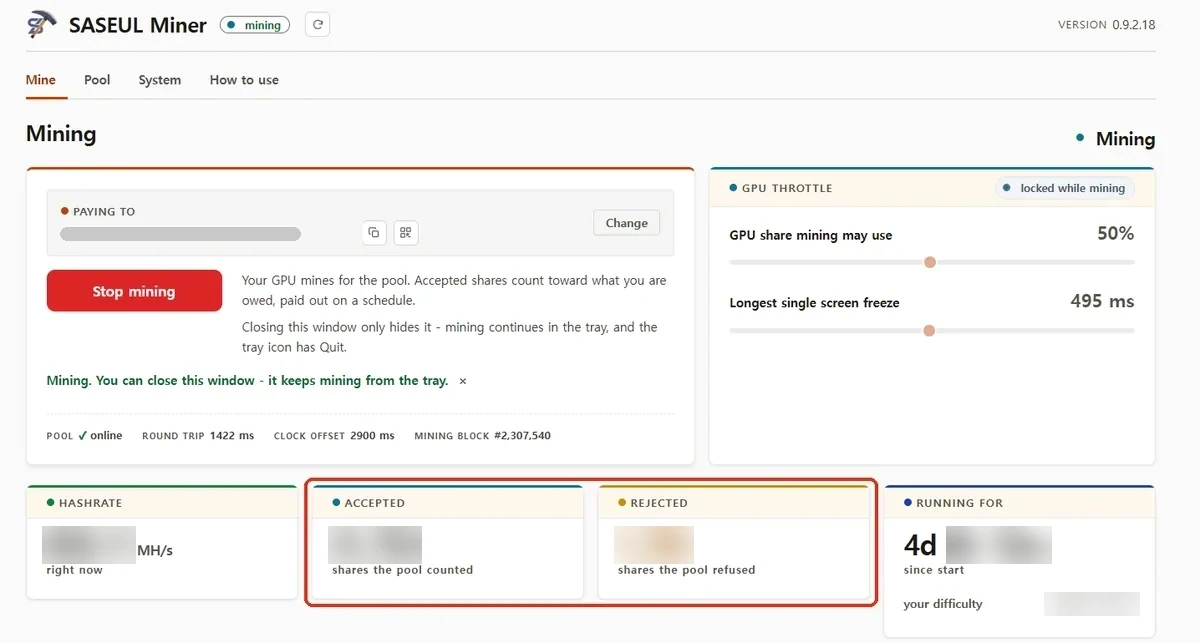
This record was made with the graphics card set to half use (50% usage). At lower usage, the mining program lets go of the card often. So you can still use the same computer for the internet or documents while it mines.
Can you now tell how to mine, and whether anything's left after electricity?
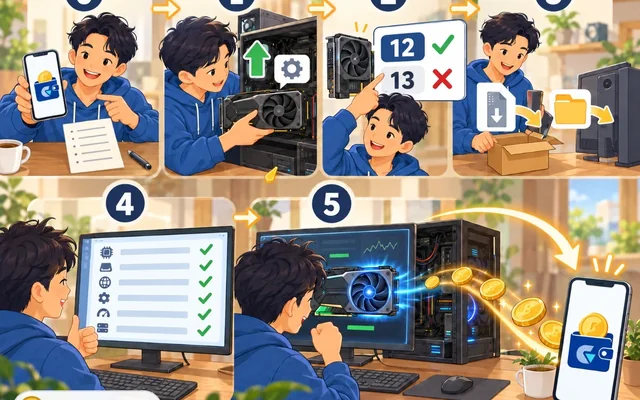
Yes, you can now tell how to mine. You need two graphics card programs from NVIDIA, the mining program, and an address to receive coins (like a bank account number). Setting it up takes six steps.
People also said it was unclear whether anything was left after electricity. Here's the electricity used and the coins received, from the 28-day record.
| What | 28-day record |
|---|---|
| Extra electricity from mining | 55 W (watts). Over a month that's 39.6 kWh (the unit on your electric bill) |
| SL received per day, 28-day average | 24 (including the days when settings were still being changed) |
| SL received per day, average over the 13 days fixed at half use (50%) | 39 (including three days with none) |
| Electricity cost per SL | 12 to 20 KRW (Korean won): 12 KRW at 39 a day, 20 KRW at 24 a day. At the most expensive step of Korea's household electricity tiers (step 3), electricity only |
How much electricity it takes to mine one SL is covered in detail in the one-month record. To work it out for your own bill, multiply 39.6 kWh by your price per kWh.
Are there downsides to mining at home?
Yes. You can mine at home, but it isn't all good for an individual.
- In a notice on September 15, 2026, the SASEUL team named three pools. The notice says none of them has a formal tie with the SASEUL team, and it doesn't vouch for how reliable they are
- The 28-day record came from one of those three, saseulmine.com
- The pool is small, so the days when coins come in are uneven. Some days nothing comes in
- About 5% of the results sent to the pool were rejected. Send 100 and about 5 don't count
- Sending results to the computer the pool runs (the pool server) and getting a reply took around one second. So my guess is that results arrive late and get rejected. The farther your country or region is from the pool server, the longer this takes, which could put you at a disadvantage. Where the saseulmine.com server is located is unknown
- Running it 24 hours a day wears the card out. That cost isn't in the electricity figures
How much power does the whole SASEUL network have?
The hashrate of everyone mining SASEUL right now adds up to about 6.88 TH/s. That's the number shown on the front page of the pool site (saseulmine.com) on September 27, 2026. The same day, the statistics screen (Statistics) of the official block explorer shows 6.26 TH/s. That's the same value, just written in units of 1,024 multiplied four times (about 1.1 trillion) instead of 1 trillion.
MH/s means 1 million guesses a second, and TH/s means 1 trillion guesses a second. 1 TH/s is 1 million MH/s. Divide 6.88 TH/s by this one card (about 860 MH/s), and it's the power of about 8,000 cards of this class put together.
What did the check find?
The saying: "There are no coins left you can mine on a home computer."
What checks out now: Ethereum mining is over, and Bitcoin is mined with special machines. SASEUL can be mined by joining a pool, with one graphics card in a home PC and home internet. But the pool behind the record is small, so coins don't come in evenly.
Sources
- ddengle.com mining board · "안녕하세요 사슬코인에 대해 질문드려요" ("Hi, a question about SASEUL coin") · 2024-02-25 (reply)
- ddengle.com free board · "유튜브에 보면 몇 보였던 사슬코인?…" (a post asking about SASEUL coin, title in Korean) · 2024-03-06 (post)
- Jeongbo Tongsin Sinmun · 2023 article
- SASEUL notice channel · pool list · 2026-09-15
- ethereum.org · The Merge · checked 2026-09-25
- bitcoin.org · FAQ · checked 2026-09-25
- Official SASEUL explorer Statistics (shown as about 6.26 TH/s = about 6.88 TH/s in standard units) · checked 2026-09-27 09:23
- Official SASEUL explorer screen script app.min.js (v1.6.3) (calculating speed = difficulty ÷ 60, T = units of 1,024⁴) · checked 2026-09-27
- saseulmine.com front page (network about 6.88 TH/s as shown on the pool site) · checked 2026-09-27 09:45
- Mining record: one graphics card, SASEUL Miner screens from August 18 to September 15
Next: Does SASEUL Have 20,000 Nodes, 3rd in the World? · More myths on the SASEUL basic facts page