SASEUL GPU Mining Electricity Cost, How to Work It Out Before You Mine
Working out the electricity cost of graphics card mining
All you need is three numbers
55W
Extra power from mining
720hours
24 hours a day × 30 days
39.6kWh
÷ 1000 for a month's electricity use
Rate
Price of 1 kWh at your step
Cost
Per month
The electricity cost of mining comes from "extra power × hours run × price per kWh." A graphics card that adds 55 W, run for a whole month, uses 39.6 kWh. In Korea, depending on the price step, that's between about 6,000 and 14,000 KRW (Korean won).
Power (W, how hard something is drawing electricity right now) and energy (kWh, all the electricity used at that rate added up) are different. Your electric bill charges for energy, in kWh.
The price differs from home to home. So someone else's number won't fit yours. Once you know how to work it out, you can do it with your own home's numbers.
What do you need to work it out?
Three numbers.
- The extra power mining adds. It's measured in W (watts).
- How many hours a day it runs
- What your home pays for 1 kWh (kilowatt-hour) of electricity. It's on your bill.
How do you measure the extra power?
Take the power while mining and subtract the power while not mining.
A plug-in power meter is the most accurate way. Plug the meter into the wall socket, then plug the computer into the meter. Watch the number for a few minutes with mining on, and a few minutes with it off. Then take the average of each.
The meter measures the electricity the whole computer uses. It also catches extra electricity used by parts other than the graphics card.
For example, the one graphics card in the one-month record used about 10 W when not mining and about 64 W on average while mining. So the extra power is about 55 W. This example measured only the graphics card's power.
Don't use 64 W for the math. The computer was on anyway. Only count what mining adds.
No meter? Measuring in the black window (Command Prompt)
Type the line below into Command Prompt (the black window where you type text to tell the computer what to do). nvidia-smi is a program that shows the status of an NVIDIA graphics card.
nvidia-smi --query-gpu=power.draw --format=csv -l 5
Watch it for a few minutes with mining on, and a few minutes with it off. Then take the average.
This only measures the graphics card's power. Extra electricity used by the computer's brain chip (CPU) or other parts isn't included.
How many more kWh does it use in a month?
55 W running 24 hours a day is 39.6 kWh a month. Here's the formula.
Extra power (W) × hours a day × 30 days ÷ 1000 = kWh a month
55 × 24 × 30 ÷ 1000 = 39.6 kWh. You divide by 1000 to turn W into kWh.
Why be careful with the price per kWh?
Because of tiered electricity rates (billing where the price of 1 kWh goes up in steps the more you use). Korea's household electricity works this way.
Mining electricity sits on top of what you already use. So using the average price is wrong. It's right to price it at the most expensive step you land in that month.
Be extra careful if you cross into the next step. If mining pushes you up a step in Korea, the base charge goes up (for example from 1,600 to 7,300 KRW). The part over the line gets the pricier rate. The price of the electricity you were already using stays the same.
First look at the last few months of use in the usage (kWh) box on your electric bill. Then see whether adding the mining electricity moves you to a different step. If your own power company uses steps, check the same way.
A home in Korea that uses more than 400 kWh a month is already on the most expensive step. But from December to February and in July and August, the part over 1,000 kWh gets a "super user" rate of 736.2 KRW per kWh.
The price per step and rough amounts look like this (in KRW, Korean won).
| Electricity price step in Korea (months other than July and August) | Price of 1 kWh (energy charge) | 39.6 kWh × price | Rough amount with the other charges added |
|---|---|---|---|
| Step 1 (200 kWh or less) | 120.0 KRW | About 4,750 KRW | About 6,000 KRW |
| Step 2 (201 to 400 kWh) | 214.6 KRW | About 8,500 KRW | About 10,000 KRW |
| Step 3 (over 400 kWh) | 307.3 KRW | About 12,170 KRW | About 14,000 KRW |
The prices were read from the household (low voltage) rate table on the website of KEPCO (Korea Electric Power Corporation, Korea's power company). They apply from November 9, 2023, and the rate table page was opened and checked on September 27, 2026.
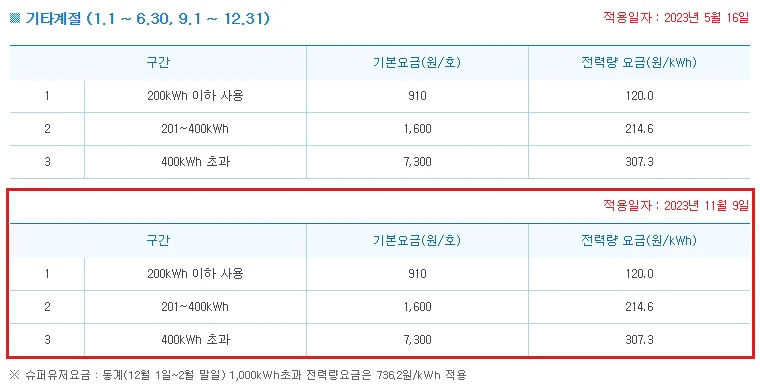
In July and August the steps are different. Step 1 is 300 kWh or less, step 2 is 301 to 450 kWh, and step 3 is over 450 kWh. The prices are the same.
Besides the energy charge, a Korean bill adds a climate and environment charge, a fuel cost adjustment, VAT and an electricity fund charge. The right-hand column estimates these the same way for all three steps.
For each kWh, I added 9 KRW for the climate and environment charge and 5 KRW for the fuel cost adjustment. Those are the figures on KEPCO's explanation page, and they can change every year or every quarter. On top of that went 10% VAT and the electricity fund.
The basic charge only changes when you move to another step, so it isn't included. Check your bill for the exact amount.
A calculator where you just type in numbers
In the rate box, enter the price per kWh for your step, from your bill or your power company's price list, in your own currency. Enter how many SL (SASEUL coins) you get a day and it also shows the electricity cost of one coin.
This calculator only multiplies kWh by your rate. The climate and environment charge, fuel cost adjustment, VAT and electricity fund aren't included. Going by the table above, a Korean bill comes out about 15 to 26% higher than the calculator shows. In other words, the bill is the calculator's number plus a tenth to a fifth, or a little more.
Are there costs besides electricity?
Yes. Running 24 hours a day wears out the fan and the material that draws heat off the chip (thermal paste). The graphics card's resale value drops too.
These costs aren't in the calculator. So the real cost should be seen as a bit higher than the calculator's number.
The power measured and the coins received over a month on one graphics card are in the one-month record. What SASEUL is, is covered in SASEUL basic facts.
Sources
- One-month mining record on one graphics card · 2026-09-16 (power measured with nvidia-smi, step amounts are rough figures)
- KEPCO rate table, household power (low voltage) (in Korean) · applied from November 9, 2023 (other seasons 200 and 400 kWh, summer July 1 to August 31 300 and 450 kWh, energy charge 120.0, 214.6 and 307.3 KRW/kWh, basic charge 910, 1,600 and 7,300 KRW, super user rate 736.2 KRW/kWh over 1,000 kWh in summer and winter) · checked 2026-09-27
- KEPCO rate structure (in Korean: climate and environment charge 9 KRW/kWh, fuel cost adjustment 5 KRW/kWh, VAT 10%, electricity fund) · checked 2026-09-27