What Is Hashrate? SASEUL GPU Mining Numbers in MH/s and TH/s Explained
What is hashrate (calculating speed)?
It's guesses per second. Size it up against the whole
860MH/s
One graphics card. About 860 million guesses a second
6.88TH/s
Everyone mining SASEUL, added up (September 27)
0.012%
One card's share. A little more than 1 slice in 10,000
Hashrate (calculating speed) is how many guesses a graphics card makes per second. It's the big number right up front when you start the mining program. There's a record of one graphics card a few years old coming in at about 860 MH/s.
That number alone doesn't give you a feel for whether it's high or low. Put it next to the number for everyone mining SASEUL and it makes sense quickly.
Is hashrate the number of guesses per second?
Mining means finding one answer that meets a condition. It isn't a problem you can just work out. You have to keep trying different numbers until one fits.
It's like scratching one scratch card after another. Hashrate counts how many guesses happen each second. The more guesses, the better the odds of finding the answer first.
Hashrate units (the letters after a hashrate, like MH/s) grow like this.
| Unit | Guesses per second |
|---|---|
| H/s | 1 |
| kH/s | 1,000 |
| MH/s | 1 million |
| GH/s | 1 billion |
| TH/s | 1 trillion |
How much does one graphics card do?
With the setting for how much of the graphics card to use (usage) at 50%, this card usually does around 800 MH/s. That means about 800 million guesses a second.
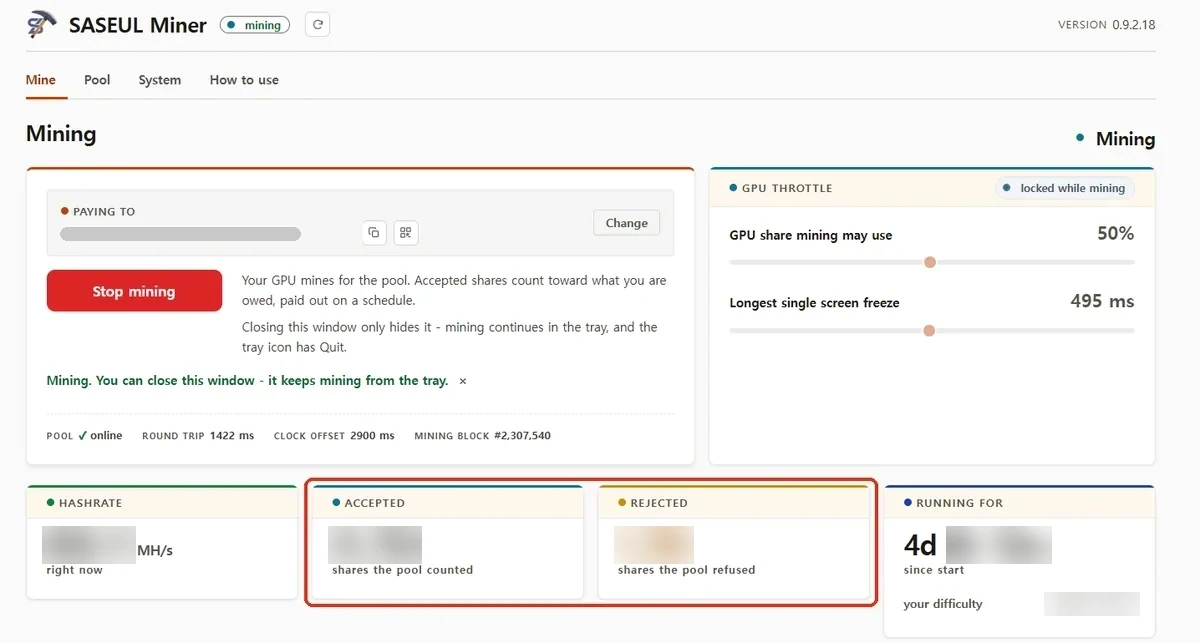
This number doesn't sit still. It keeps moving up and down between 680 and 890.
The 50% setting doesn't run the card at half strength. It runs the card flat out, then rests, over and over. I'd guess that's why the value wobbles from moment to moment.
A record of a month of mining is in the one-month record post.
Is 800 MH/s a lot?
One number can't tell you. You have to compare it with the speed of everyone mining SASEUL. That total is called the network hashrate.
On September 27, 2026, the figure for all of SASEUL was about 6.88 TH/s. That's the value shown on the front page of the pool site (saseulmine.com) that day. Working it out from the statistics screen (Statistics) of SASEUL's official records site (explorer.saseul.com, the official block explorer) gives the same value.
Why does the explorer show 6.26 TH/s?
The explorer screen shows it as 6.26 TH/s. The explorer counts T as 1,024 multiplied four times (about 1.1 trillion), not 1 trillion, so the same value just looks smaller.
Put this card's roughly 860 MH/s in and divide: 0.86 ÷ 6,880 ≈ 0.012%. Cut all of SASEUL into 10,000 slices and it's a little more than one slice.
Below are the numbers shown on the front page of one mining pool (a group that mines together and splits the coins) site at 18:33 on September 23.
| What (September 23, 18:33) | Number |
|---|---|
| Everyone mining SASEUL, added up (shown on the pool site) | About 6.67 TH/s |
| Calculating speed gathered in this pool (saseulmine.com) | 12.80 GH/s |
Inside the pool at that moment, this card was about 6.7%. That's about 6 or 7 people's share out of 100.
When the pool finds an answer, each member gets a share by how much calculating they added. So what decides how many coins you get is this ratio, more than the card's number itself.
Even with the same card and the same setting, the result changes. When the total grows, you get less. When it shrinks, you get more.
Does the network hashrate stay the same?
No, it changes as miners come and go. But each place that shows it gives a different number, so look at the date and the source together.
| Date | Where it was shown | All of SASEUL |
|---|---|---|
| September 15 | Mining program's pool screen (Pool tab). Same math as the explorer | About 9,875 GH/s (about 9.88 TH/s) |
| September 23 | Pool site (saseulmine.com) front page | About 6.67 TH/s |
| September 27 | Pool site (saseulmine.com) front page | About 6.88 TH/s |
| September 27 | Official block explorer statistics screen | Shown as 6.26 TH/s (in units of 1,024. About 6.88 TH/s in standard units) |
1,000 GH/s make 1 TH/s. 9,875 GH/s is about 9.88 TH/s.
Can the September 15 number be compared directly?
The September 15 number from the mining program is worked out the same way as the explorer's. Take the mining difficulty (how hard it is to find the answer) recorded on the official explorer for September 15, divide by 60, and it matches to two decimal places. So the two days can be compared directly.
From about 9.88 TH/s on September 15 to about 6.88 TH/s on September 27, it dropped by about 30%. The total mining power on SASEUL really did go down.
Here's what that means for the share of the same card at about 860 MH/s.
Share of all SASEUL mining for one card at about 860 MH/s
When the total fell by about 30%, the same card's share grew about 1.4 times.
Comparing the same pool site with itself, it's 6.67 TH/s on September 23 and 6.88 TH/s on September 27, about the same. The mining difficulty on the same official block explorer didn't change much either: 363T on September 23 and 375.57T on September 27.
Is a high hashrate all that matters?
Not really. A pool pays out by the shares (receipts for the work you added to the pool) it accepts. Shares that arrive late or don't meet the rules are rejected and don't count.
A screen after more than 4 days of mining showed about 32,000 accepted and about 1,700 rejected. About 5% were thrown away. That's about 5 out of 100.
Set the card to 100% and the hashrate goes up. But it uses more electricity and the fan gets louder. I think it's right to look at the rejected share and the electricity too, not just one number.
Where can you see the hashrate?
- The calculating speed (HASHRATE) box on the mining program's mining screen (Mine tab): the card you're running now
- The front page of saseulmine.com: the whole pool and all of SASEUL
- Basic facts about SASEUL and numbers logged every day: SASEUL basic facts
If you want to start with setup, see how to set it up first.
Sources
- Official SASEUL explorer Statistics (difficulty 375.57T, shown as about 6.26 TH/s = about 6.88 TH/s in standard units) · checked 2026-09-27 09:23
- Official SASEUL explorer screen script app.min.js (v1.6.3) (calculating speed = difficulty ÷ 60, T = units of 1,024⁴) · checked 2026-09-27
- saseulmine.com front page (whole pool, network hashrate shown on the pool site) · checked 2026-09-23 18:33 and 2026-09-27 09:45
- Explorer difficulty 363T · value from the daily log, 2026-09-23
- SASEUL Miner program, Pool tab (network about 9,875 GH/s) · 2026-09-15
- Official SASEUL explorer, resource block #2,307,600 (2026-09-15 12:06 KST, difficulty 592,512,823,647,550 ÷ 60 ≈ 9,875.21 GH/s. The same value is in the Difficulty History on the Statistics page) · checked 2026-09-27
- SASEUL Miner program, Mine tab (one graphics card, about 860 MH/s) · 2026-09-15