Does SASEUL Have 20,000 Nodes, 3rd in the World? The Official Count on September 27, 2026 Was 74
SASEUL myth check, part 2
20,000 was the official figure in 2024. The official count on September 27, 2026 was 74
What people say (a 2023 article; 20,000 also in a 2024 notice)
“20,000 computers hold the record book, more than Bitcoin”
Going by the official explorer in September 2026
An old official figure, not today's
- 74 computers hold the record book
- 46 of them are mining
- September 27, 2026
It's an old official figure, not today's number. In an official notice on May 16, 2024, the SASEUL team said about 20,000 nodes were running. A November 2023 article also said "SASEUL has 20,000 nodes, more than Bitcoin." On September 27, 2026, the official SASEUL explorer shows 74.
What is a node?
Coins run on a record book. It lists who sent how much to whom. No single bank keeps this book.
Lots of computers each hold an identical copy of it. Each of these computers is called a node (a computer holding a copy of the record book). Think of a savings club where every member keeps their own copy of the club's ledger.
More nodes means more computers guarding the record book. That's why coin projects like to show off their node count.
Where did the 20,000 figure come from?
From 2023 news articles, and a 2024 official SASEUL notice. Here they are in date order.
| When | Number given | Where |
|---|---|---|
| January 2023 | About 30 | Issue&Biz |
| End of April 2023 | About 600 | Same article |
| August 23, 2023 | 1,100 nodes that mined successfully | Korea IT Times |
| September 20, 2023 | Over 5,000. "Third after Bitcoin and Ethereum" (said by the vice president of Artifriends, the company that made SASEUL) | Blockchain Today |
| November 13, 2023 | Over 16,000 | Seoul Shinmun |
| November 14, 2023, as of 4 p.m. (article on the 15th) | 20,000 | Eroun Net |
| May 16, 2024 | About 20,000 (mainnet 2nd anniversary notice, announced by the SASEUL team) | Official SASEUL notice #57 |
These are Korean news sites. The article with 20,000 also made a comparison: more than Bitcoin's 16,700 and Ethereum's 7,700.
The "3rd in the world" line came earlier, in a May 19, 2023 article (with end-of-April figures). It meant third among coins whose node you can install on a home computer, after Bitcoin and Ethereum.
The 20,000 figure showed up again on May 16, 2024, at 11:13 p.m. Korea time, in an official SASEUL Telegram notice (#57), the mainnet's 2nd anniversary post. The original says "approximately 20,000 nodes running." That's the figure the SASEUL team officially gave.
Back when the 20,000 figure was going around, SASEUL was mined with CPUs (the computer's main processor chip). A March 2024 Sankyung e-News article also called it mining "done with CPUs."
How many are there now?
The official SASEUL block explorer (the official site that lets anyone look at the record book) was checked twice. The screen below is the front page on the evening of September 23, 2026.
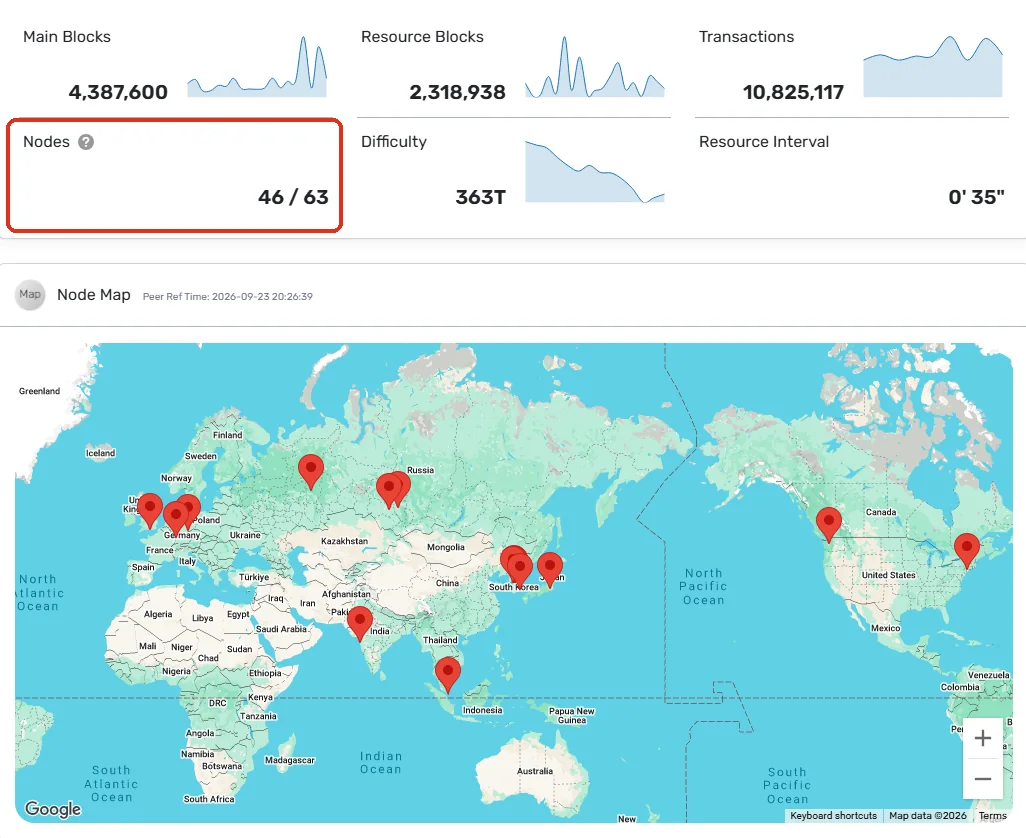
On September 23, the red box says "46 / 63". The question mark next to it explains what they mean.
- First number: how many places are mining (Active Miner)
- Second number: how many computers hold an up-to-date copy of the record book (Synced Node)
At 9:23 in the morning on September 27, 2026, the statistics screen (Statistics) was checked again. This time it said "46 / 74". But this number changes within minutes. The explorer only shows the number at the moment you open it. The same day the front page was back to 46 / 63 at 9:56. At 10:00 the statistics screen showed 74 computers with an up-to-date ledger.
| When it was read | Places mining | Computers with an up-to-date record book |
|---|---|---|
| September 23, 2026, 20:26 | 46 | 63 |
| September 27, 2026, 9:23 | 46 | 74 |
| September 27, 2026, 9:56 | 46 | 63 |
| September 27, 2026, 10:00 | not shown | 74 |
Nothing says whether 46 is a count of computers. If several computers mine as one team, they might count as one place. So my guess is it could differ from the number of graphics cards actually running.
The node map on the September 23 front page showed 17 cities. Many are in Korea, like Seoul, Seongnam, Goyang and Gwangmyeong. Tokyo, Singapore, Mumbai, Seattle and Novosibirsk are there too.
Why did it drop from 20,000 to 74?
Public sources don't say why it dropped. The 74 on September 27 is about 1/270 of 20,000.
So saying "SASEUL has 20,000 nodes" today isn't right. Look at the 2024 official figure and the September 2026 explorer count, each with its date.
So has mining gotten easier?
No. It's actually gotten harder. There are fewer nodes, but mining difficulty (how many calculations it takes on average to find one block) is now about 47,000 times what it was in May 2024. That compares the morning of September 27, 2026 with the night of May 16, 2024, when the team officially announced 20,000 nodes.
When difficulty goes up, the same computer gets fewer coins. Your share is set by how much of the network hashrate (the combined calculating speed of every computer mining) your computer makes up. When the total grows, your slice gets smaller.
The node count tells you how many computers hold the record book. Difficulty shows how fast all the mining computers are calculating together. So the two can move separately.
The machines changed too, from CPUs to graphics cards. Until the official docs were edited on March 9, 2026, their install specs listed only CPU, memory and storage. No graphics card.
The official graphics card (GPU) miner first came with the February 13, 2026 node update (2.2.0.1). The update history in the official docs calls it an "experimental GPU miner." I couldn't find public records of whether unofficial GPU miners were running before that. There's more on what it's mined with in this post.
Within about a month of the official GPU miner coming out, difficulty jumped about 11 times. So the move from CPUs to graphics cards looks like it pushed difficulty up. That's my guess.
The same update changed a lot of other things too. And before the GPU miner came out, difficulty was already about 12,000 times the May 2024 level.
Back in the CPU days, in early 2024, difficulty also went up about 2.5 times in a month.
Difficulty numbers in detail (table by date, the big jumps, how to check it yourself)
I looked up the difficulty on each date in the official explorer's mining record pages (resource blocks). Divide difficulty by 60 seconds and you get the calculating speed of the whole SASEUL network. How that division works is in the difficulty post.
| When (Korea time) | Mining record page no. | Difficulty | Network calculating speed |
|---|---|---|---|
| Nov 14, 2023, 16:00 (the time the 20,000-node article counted from) | 803,440 | 2,882,975,130 | about 48 million per second |
| May 16, 2024, 23:12 (one minute before notice #57 went up) | 1,070,330 | 8,808,793,144 | about 147 million per second |
| Sep 27, 2026, 9:22 | 2,324,047 | 412,942,642,739,300 | about 6.88 trillion per second (6.88 TH/s) |
Compared with May 2024 that's about 47,000 times. Compared with November 2023 it's about 140,000 times. Difficulty swings up and down by about two times within a few weeks. On September 9, 2026 it was about 840 trillion, and on September 24 about 408 trillion. Still, a gap of tens of thousands of times is far bigger than that swing.
I pulled difficulty from the official node's records every half month or so. It jumped hard twice.
- Mid-August 2024, about 8.2 billion → January 20, 2025, about 1.9 trillion (about 230 times). That's about a year and a half before the official GPU miner. In its September 14, 2024 official notice (#61), the team said more than half of the mining nodes had changed their code and settings against its guidelines
- February 12, 2026 (the day before the update), about 106 trillion → March 20, about 1,191 trillion (about 11 times). That's within about a month of the official GPU miner coming out
After March it came back down. On September 27 it was about 3.9 times the day before the update.
Difficulty also shot up in a short time back in the CPU days. The official node's records show it went from about 3.76 billion on January 25, 2024 to about 9.33 billion on February 23. That's about 2.5 times in a month.
Open a mining record page in the official explorer and you'll see its time (Block Timestamp) and difficulty (Difficulty). The three pages in the table open directly from these links.
- No. 803,440 (Nov 14, 2023, 16:00)
- No. 1,070,330 (May 16, 2024, 23:12)
- No. 2,324,047 (Sep 27, 2026, 9:22)
I also checked the pages before and after on the same days. Difficulty didn't change page by page. It changed about once a day. On November 14, 2023 it was 2,882,975,130 up to 17:27 (no. 803,520) and 2,955,049,508 from 17:28 (no. 803,521). From 15:53 on May 16, 2024 (no. 1,069,921) to 17:01 on May 17 (no. 1,071,360) it stayed at 8,808,793,144.
After the July 20, 2023 release (2.1.9.6), the next SASEUL node software update was on February 13, 2026 (2.2.0.1), according to the update history in the official docs. The day before that update, at 12:00 on February 12, 2026 (no. 1,996,982), difficulty was 105,799,272,487,067. That was already about 12,000 times the May 2024 figure.
Here are the other pages mentioned above. No. 1,205,000 (Aug 18, 2024, 12:53): 8,172,121,495. No. 1,435,000 (Jan 20, 2025, 4:10): 1,891,435,561,572. No. 2,052,001 (Mar 20, 2026, 5:33): 1,190,688,242,730,424. Around the time of the ddengle reply: no. 907,201 (Jan 25, 2024, 11:47) 3,761,917,680, and no. 950,401 (Feb 23, 2024, 14:25) 9,329,819,726.
The T on the explorer's statistics screen is a unit of 1,024 multiplied four times. The speeds in the table above use the standard unit (1 trillion = 1T).
What does this mean for miners?
Fewer nodes doesn't mean a bigger share for you. Your share isn't set by the number of places mining. It's set by how much of the network hashrate your card makes up.
Even with 46 places mining, if a few of them run very powerful machines, your share is small. And even with many places, if they're all weak, your share could be bigger.
Take one graphics card with a calculating speed of about 860 MH/s. The network hashrate on September 27, 2026 was about 6.88 TH/s. This card is about 0.012% of that. Cut the whole into 10,000 slices and it's a little over one slice. How these numbers are counted is in the hashrate post.
Having few nodes matters in a different way. Few computers are guarding the record book. I'd guess that if several of them stop at once, the impact could be big.
What did the check find?
The saying: "SASEUL has 20,000 nodes, more than Bitcoin, 3rd in the world."
The verdict: it's an old official figure, not today's. In its official notice of May 16, 2024 (#57), the SASEUL team said about 20,000 nodes were running. There's also a November 15, 2023 article giving 20,000 as of 4 p.m. on November 14. "3rd in the world" is how 2023 articles (May and September) put it.
At 9:23 on September 27, 2026, the official explorer showed 74 computers with an up-to-date record book, 46 of them mining. On September 23 it was 63.
Nodes went from about 20,000 in the 2024 official announcement to 74 on September 27, 2026. But mining difficulty grew about 47,000 times over the same period (official explorer mining records). The node count is how many computers there are, and difficulty is how much calculating they do, so the two move separately.
Sources
- Issue&Biz · 2023-05-19
- Korea IT Times · 2023-08-23
- Blockchain Today · 2023-09-20
- Seoul Shinmun · 2023-11-13
- Eroun Net · 2023-11-15
- Official SASEUL Telegram notice #57 · mainnet 2nd anniversary, about 20,000 nodes · 2024-05-16 23:13 (Korea time), original checked 2026-09-27
- Official SASEUL explorer front page (node count, node map) · checked 2026-09-23 20:26
- Official SASEUL explorer mining record pages (Resource Block) no. 803,440 · no. 1,070,330 · no. 2,324,047 (time, difficulty) · checked 2026-09-27. The pages before and after, and no. 1,996,982 on February 12, 2026, were checked by asking the official node the explorer uses (main.saseul.net) by page number
- Official SASEUL docs · Updates · Node (2.1.9.6 2023-07-20, 2.2.0.1 2026-02-13, "experimental GPU miner") · checked 2026-09-27
- Official SASEUL docs on GitHub · Installation, the version before the March 9, 2026 edit (specs: 2 Core CPU, 8 GB RAM, 256 GB SSD, no graphics card. Posted 2023-04-04) · checked 2026-09-28
- Sankyung e-News · "스마트시티도 '사슬'로 통합, 운영…스마트슬랩스-아티프렌즈, 사슬 블록체인 생태계 활성화 MOU 체결" (an article on a SASEUL ecosystem agreement, title in Korean; mining "done with CPUs") · 2024-03-29
- Official SASEUL Telegram notice #61 · nodes that changed code against guidelines, network slowdown · 2024-09-14, original checked 2026-09-28
- Official SASEUL Telegram notice #73 · hard fork update released, very large scope of changes · 2026-02-13
- ddengle.com mining board · "안녕하세요 사슬코인에 대해 질문드려요" ("Hi, a question about SASEUL coin") · 2024-02-25 (reply), original checked 2026-09-28
- When difficulty jumped: I asked the official node (main.saseul.net) for a mining record page every 21,600 pages (about half a month) from May 2022 to September 2026, and looked closer at the big jumps · checked 2026-09-28
- Official SASEUL explorer statistics screen (Statistics: nodes 46 / 74, network hashrate shown as about 6.26 TH/s = about 6.88 TH/s in standard units) · checked 2026-09-27 09:23 (nodes 46 / 63 on the front page at 09:56, 74 on the statistics screen at 10:00)
Previous: Can You Still Mine Crypto on a Home GPU? · Next: What Do You Mine SASEUL With, a Hard Drive, CPU or GPU? · More myths on the SASEUL basic facts page