Is SASEUL 1000 Times Faster Than Bitcoin? The Public Numbers Don't Get You to 1000x
SASEUL myth check, part 4
By the public numbers it's faster than Bitcoin. But no number gets you to 1000x
What people say (a 2022 headline)
“1000 times faster than Bitcoin”
Working it out from public numbers
No basis for 1000x
- Official docs: final in 6 to 8 seconds
- CoinMarketCap: final in about 10 minutes
- Neither comes to 1000x
No evidence for 1000x was found. By the public numbers, SASEUL is faster than Bitcoin. But whichever of those numbers you use, it doesn't come to 1000x.
SASEUL's numbers differ from source to source. They also change depending on what you measure.
What does "fast" mean here?
When you send coins, it goes through two steps.
- It gets written in the record book. From here on, there's a record of the transfer
- The record becomes final. From here on, no one can undo it
Faster is better for both steps. But "how many times faster" changes depending on which step you measure. It's like a parcel: the time it's accepted and the time it arrives aren't the same.
Where did the 1000x claim come from?
From articles on June 8, 2022. Here's how events went, by date.
- May 17, 2022, 4:49 a.m. (Korea time): the first page of the record book on the SASEUL mainnet (the network running for real after testing ends) was created. This is the start time (Genesis Datetime) on the official explorer's statistics screen. In UTC it's May 16
- June 8, 2022: articles announced the mainnet launch, about three weeks after it started running. Electronic Times and Newsis, both Korean news outlets, put 1000x in their headlines
But the articles don't say what was compared. They don't say whether it's the time to be written in the record book or the time to become final. They don't say how it was measured either.
The basis given in the Newsis article was the CEO's statement that it runs "about 1000 times faster than Bitcoin."
The phrase is still used today. The first line of the iPhone App Store description for Guardee, the official SASEUL wallet (an app to receive and send coins), says "a blockchain engine 1,000 times faster than Bitcoin" (in Korean). When the App Store page was opened again on September 27, 2026, the line was still there.
Neither the articles nor the app description say what was compared. The public numbers don't work out to 1000x.
Worked out again from public numbers, how many times faster is it?
SASEUL's times appear in two places. But the two places give different numbers.
| Where it appears | Time to be written in the record book | Time to become final |
|---|---|---|
| Official SASEUL docs (updated March 9, 2026) | Not given | 6 to 8 seconds |
| SASEUL project description on CoinMarketCap | About 4 seconds | About 600 seconds (10 minutes), after 10 more record book pages pile up |
CoinMarketCap is a site that gathers information on coins from around the world. Which of the two is right is unknown. My guess is they measured by different standards.
For Bitcoin, the widely known numbers were used.
- About 10 minutes on average to be written in the record book
- About 1 hour until the record is considered final (people usually wait for 6 more record book pages)
First, using the CoinMarketCap numbers:
| What's measured | SASEUL (CoinMarketCap) | Bitcoin | How many times faster SASEUL is |
|---|---|---|---|
| Time to be written in the record book | About 4 seconds | About 10 minutes | About 150x |
| Time to become final | About 10 minutes | About 1 hour | About 6x |
By the CoinMarketCap numbers, SASEUL takes 4 seconds, not even enough to boil water for instant noodles. Bitcoin takes 10 minutes, long enough to eat a whole bowl.
With the official docs' 6 to 8 seconds, it changes. Compared with Bitcoin's 1 hour (3,600 seconds) to become final, that's about 450x to 600x. Much bigger than the roughly 6x from the CoinMarketCap numbers.
Still, no number gets you to 1000x.
Judge speed by when it becomes final
More than "how many times faster," what matters is how long a record takes to become final. This is also called finality. Whoever receives coins can only relax, hand over the goods, or spend those coins again once the record is final. However fast something is written in the record book, you still wait until it's final.
SASEUL's white paper makes this point too. How it makes records final quickly is in SASEUL has two record books?.
What about transactions per second?
No public measurement of how many transactions SASEUL can handle per second was found.
In fact, right now there aren't enough transactions to measure it. You can see this on the official SASEUL block explorer (the official site that lets anyone look at the record book).
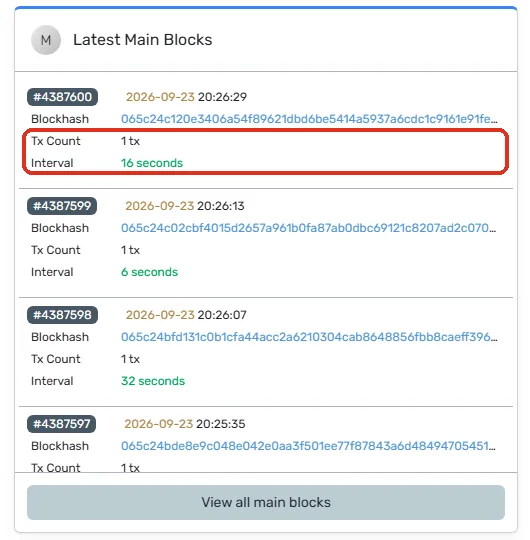
The record book pages in the screenshot each had 1 transaction. The gap between pages jumped around: 6, 16 and 32 seconds. It looks like a page is made each time a transaction comes in.
When it's this quiet, one thing can't be known: how well it holds up when lots of transactions come in at once.
At 9:23 a.m. on September 27, 2026, the explorer's statistics screen showed 10,843,603 transactions in total so far. That's about 10.84 million. Over more than four years, that's about a fifth of South Korea's population.
Does this matter to miners?
It has nothing to do with how much you get from mining. The SASEUL coins (SL) you get from mining aren't tied to transaction speed. They come from the share your mining pool (a group that mines together and splits the coins) has mined.
However many times faster it is, the record from one graphics card stays the same: 24 coins a day on average over 28 days (about 39 a day for the 13 days after the setting was fixed at 50%).
But if numbers whose basis can't be confirmed keep going around, people seeing SASEUL for the first time may find it hard to trust the other explanations too. So I think sticking to confirmed numbers is better for miners too.
What did the check find?
The saying: "SASEUL is 1000 times faster than Bitcoin."
What checks out now: the 2022 articles didn't say what was compared. Guardee's App Store description (checked September 27, 2026) also has the "1,000 times" line, and it doesn't say what was compared either.
SASEUL's times differ by source. The CoinMarketCap description says about 4 seconds to be written in the record book and about 10 minutes to become final. By those numbers, it's 6x to 150x faster than Bitcoin. The official docs say 6 to 8 seconds to become final. Comparing time to become final with that, it's about 450x to 600x. Neither is 1000x.
When judging speed, look at the time to become final rather than "how many times faster." That's what decides when the receiver can relax.
No public measurement of transactions per second was found.
Sources
- Electronic Times (etnews) · 2022-06-08
- Newsis · 2022-06-08
- App Store · Guardee ("1,000 times" in the first line of the description) · checked 2026-09-24, 2026-09-27
- SASEUL Docs · Overview (6 to 8 seconds to become final) · updated 2026-03-09, checked 2026-09-27
- SASEUL project description on CoinMarketCap (processed in about 4 seconds, final after 10 resource blocks, about 600 seconds) · checked 2026-09-23, 2026-09-27
- Official SASEUL explorer (Latest Main Blocks) · checked 2026-09-23
- Official SASEUL explorer statistics screen (total transactions, start time) · checked 2026-09-27 09:23
- The "how many times" figures compare the times in the CoinMarketCap description and the official docs with Bitcoin's widely known average times (Bitcoin's time divided by SASEUL's time)
Previous: What Do You Mine SASEUL With, a Hard Drive, CPU or GPU? · Next: Does SASEUL Have No Block Explorer and No Listing on Coin Sites? · More myths on the SASEUL basic facts page