What Is Pool Hopping in SASEUL Mining? Whether Moving Around Pays Depends on the Pool's Reward Rules

What is pool hopping?
Joining only when it looks favorable, then leaving
Join when a new round starts
Few shares have piled up this round
Leave when the round drags on
Each share is worth less
Steady miners' share shrinks
Depends on the payout scheme
Pool hopping means joining a pool (a group that mines together by combining their power) only when the rewards look favorable, and leaving when they look worse. In a pool where the value of the same work depends on when you joined, hopping can earn you more, and the extra comes out of the pockets of the people who stayed. That is why other ways of splitting rewards were invented to narrow the gap. The home page and download guide of the SASEUL community pool saseulmine.com don't give the name of the scheme it uses, so this post can't say which one it is.
In a proportional pool, joining early in a new round pays better
A pool counts the time until it finds one block (one page of the ledger) as a round. The work you add is counted in shares (receipts for the work you contributed), and when the pool finds a block, the reward is split by number of shares. That is the proportional scheme. The Bitcoin Wiki describes it as splitting the reward in proportion to the number of shares each person submitted once a block is found (checked November 9, 2026).
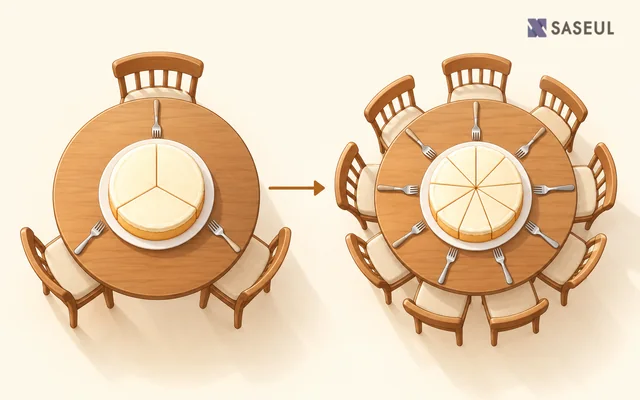
The catch is that the longer a round runs, the less each share is worth. The same reward is shared among a share count that keeps growing. It is like cutting one cake while more and more raffle tickets keep being handed out. So someone who joins early in a round and moves to another pool once the round drags on comes out ahead. Meni Rosenfeld's paper works through the proportional scheme and shows that once the shares piled up in a round pass a certain level, the expected payout of a newly submitted share falls below its fair value (that threshold is 43.5% of the difficulty). A hopper works only before that point and leaves.
The paper also points out the cost. A pool's total reward is fixed, so whatever a hopper takes extra, the steady miners get less. In the worst theoretical case for a proportional pool, it says a steady miner could receive about 43% less than they would without hopping (arXiv 1112.4980, version submitted December 21, 2011). The earlier 43.5% is the point where hoppers leave, and this 43% is how much less steady miners get, so they are different numbers. Neither was measured on a SASEUL pool. The paper adds that in practice it would be much smaller, depending on how many people hop and how skilled they are.
PPLNS looks at recent shares, which reduces the advantage of hopping
If rewards are split regardless of round boundaries, the gap in "joining early in a round pays more" gets smaller. The best-known example is PPLNS (Pay Per Last N Shares). The Bitcoin Wiki's pool comparison page describes PPLNS as similar to the proportional scheme, but looking at the last N shares regardless of round boundaries (checked November 9, 2026). At the moment a block is found, those who submitted many recent shares get paid, so the benefit of timing your entry to an early round and then leaving shrinks. How much it actually blocks hopping depends on the details of the rules.
There was also a scheme that gives older shares a lower score to reduce the urge to switch pools. The Bitcoin Wiki says it lowers the incentive to cheat by switching pools within one round. The paper points out limits there too, while making clear that some schemes hold up well against hopping. It says even PPLNS divides into variants that resist hopping and ones that don't.
The SASEUL community pool's records show calculating speed moving a lot once, but that alone doesn't show hopping
saseulmine.com, a community pool that is not run by the SASEUL team, says "Split by the work each address did." The miner gets 80%, the referrer 10%, and the pool 10%, and an amount below the minimum rolls over to the next payout (checked November 9, 2026). I could not find whether it is proportional or PPLNS in this guide.
From the pool screen values this blog records every day, the pool's calculating speed was 156 GH/s on October 24 and dropped to 69.7 GH/s about 21 hours later. On November 9 at 9:57 am it was 43.95 GH/s. GH/s and TH/s are units of calculating speed, and 1 TH/s is 1,000 GH/s. Over the same period the whole SASEUL network went from 3.73 TH/s to about 13.77 TH/s. The details of that trend are in the 3x in 9 days post.
Two numbers at two points in time can't tell me why the calculating moved. There is no data on whose calculation came and went, so I can't say it was hopping, and I can't say it wasn't.
So what should I do? When choosing a pool, check the reward rules and the payout conditions together
- Look for four things in a pool's guide: which shares count toward rewards (this round only, or the last N), the fee, the minimum payout, and how the leftover share is paid out after you leave
- If the guide doesn't say, you can ask the pool operator or the guide channel about those four things
- If you don't know the reward rules, it's hard to calculate whether moving pays off. Check the rules before you move
- Look at your share as an average over several days. A daily share that bounces around is normal even without hopping. The reason is in the mining pool post
- If you're curious about the network-wide numbers, see the difficulty post and the SASEUL basics page
Sources
- Meni Rosenfeld, Analysis of Bitcoin Pooled Mining Reward Systems (arXiv, submitted December 21, 2011) · I read the principle of pool hopping (43.5%), its effect on steady miners, and PPLNS in the main text · checked 2026-11-09
- Bitcoin Wiki, Comparison of mining pools (description of Prop. and PPLNS) · checked 2026-11-09
- Bitcoin Wiki, Pooled mining (description of the slush scheme) · checked 2026-11-09
- SASEUL Mining Pool home (POOL HASHRATE 43.95 GH/s, NETWORK ≈ 13.77 TH/s, POOL SHARE 0.3%, AVG TIME TO BLOCK ≈ 5 h) · a community pool, not run by the SASEUL team, checked 2026-11-09 09:57
- SASEUL Mining Pool download guide ("Getting paid": 80%, 10%, 10%, "Split by the work each address did") · checked 2026-11-09
- This blog's daily records (pool screen) · 2026-10-24 05:31, 2026-10-25 02:49
- What is a mining pool · 3x in 9 days (this blog)
This is a how-to explanation, not investment advice. I hold SL. I read the pool numbers directly from the pool site's screen around 9:57 am on November 9, 2026, and the past values are the records this blog kept on those days. The Bitcoin pool descriptions don't tell us how the SASEUL pool splits rewards.